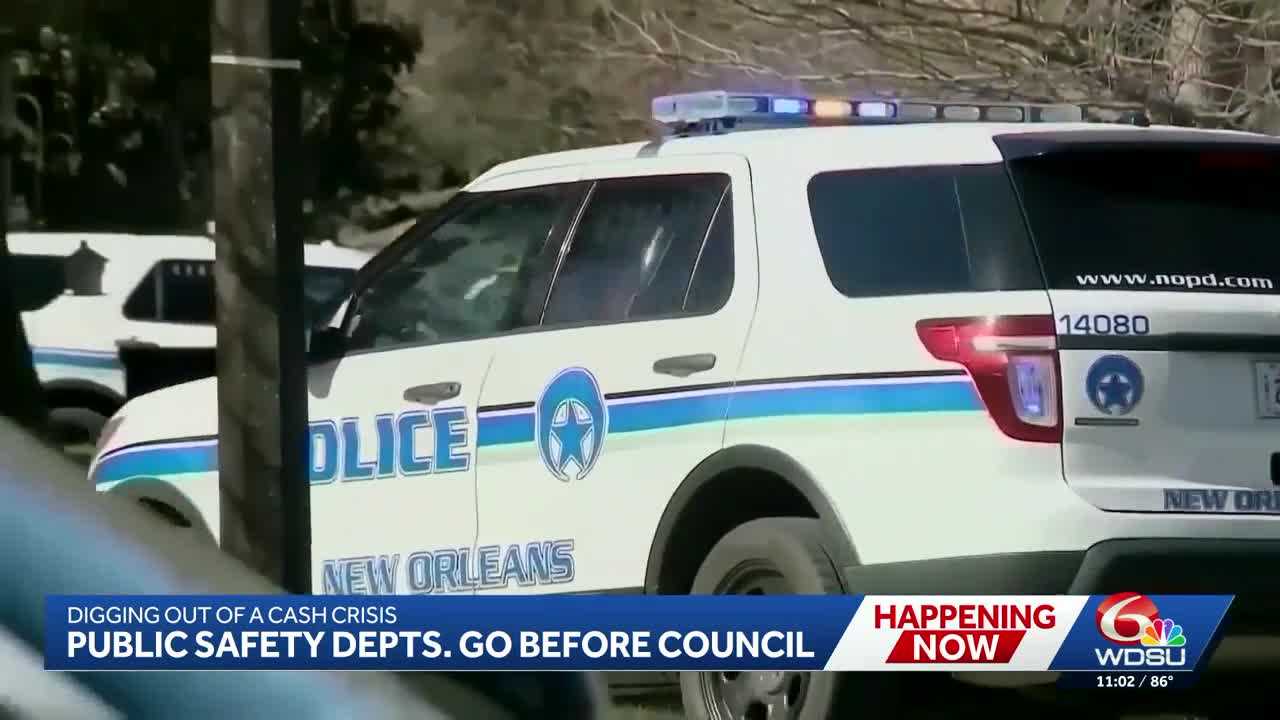
New Orleans public safety officials spoke before the New Orleans City Council Wednesday for budget hearings.
This comes as the New Orleans Police Department faces a 2% reduction, and the NOFD faces a 10% reduction in budget.
New Orleans Police Department Superintendent Anne Kirkpatrick told the City Council that NOPD is prepared to work with city officials to close a budget gap, but warned that some proposed reductions could shift administrative and traffic-related responsibilities back to commissioned officers.
The proposed 2027 budget provides $167.1 million for NOPD.
This is $3.2 million less than what the department expects to spend this year. However, it is about $2.8 million more than NOPD’s $164.3 million adopted 2026 budget.
Kirkpatrick highlights progress in recruiting, crime reduction
Kirkpatrick presented the department’s recent crime statistics and recruitment gains as evidence that NOPD has made progress despite financial and staffing constraints.
The department reported that its median response time for emergency calls is 9.4 minutes. Kirkpatrick also said murders have fallen by approximately 65% since 2022, while the number of applicants seeking to join the department has increased by 65%.
Kirkpatrick said NOPD has reduced crime while remaining below its 2026 overtime budget and its 2025 overtime spending level. She also highlighted several internal efficiency measures, including reviewing contracts and hiring a comptroller to improve financial oversight.
Concerns with civilian staffing cuts:
The proposed budget suggests a reduction of $4.3 million, with the majority of cuts coming from civilian positions.
Kirkpatrick cautioned that the work performed by those employees would not disappear and would fall back on uniformed officers.
Council members asked NOPD to provide a detailed list of affected positions and explain where their duties would go.
Councilmember Matthew Willard said one of the “toughest to swallow” proposals was the effect that civilian reductions could have on traffic response. He said the city couldn’t go back to days when people waited hours for assistance.
The proposed budget would also eliminate approximately $1.3 million for On Scene Services, which provides civilian responses to certain traffic incidents.
Kirkpatrick said NOPD has considered establishing an in-house replacement unit which would require about ten people and take about three months to bring online. The NOPD would also have to hire and train employees while also obtaining vehicles, uniforms and equipment.
Council members discussed several alternatives, including using Louisiana State Police for some highway crashes or rebidding the existing contract to find an option that fits within the city’s budget.
City council members stressed that any replacement could not increase wait times at crash scenes or take patrol officers away from their primary duties.
Parking and towing transfer remains unfinished
Kirkpatrick also addressed taking on parking, booting, and towing services which were previously handled by the Department of Public Works.
Approximately $8.6 million in the department’s budget is associated with parking and towing enforcement. The department is continuing to hire employees to fill vacancies, according to Kirkpatrick.
Council President J.P. Morrell said the transfer was appropriate, particularly because the city had wanted to expand nighttime towing. However, he warned that unfilled positions could leave significant revenue uncollected.
Morrell said that towing, paid details and similar functions should be viewed as parts of a larger public-safety network. He said if it is managed effectively, revenue-producing operations could offset costs and reduce pressure on the city’s General Fund.
“You can’t fund one piece of that network and defund the other,” Morrell said, addressing how NOPD’s recent efforts have led to crime reduction.
The discussion also addressed officer equipment and uniform stipends. Morrell suggested that revenue generated by paid details and related work could be used to provide officers with equipment directly rather than relying on stipends.
Axon reduction concerns:
The city’s budget proposal also reduces the department’s Axon contract by $2.5 million. The contract covers body-worn cameras, in-car cameras and tasers.
Kirkpatrick said one possible consequence discussed during the hearing was that detectives might no longer wear body cameras, though details are still being ironed out.
Council members asked NOPD to provide more detail about which officers, units and pieces of equipment would be affected.
While some speakers questioned spending on surveillance technology, Councilmember Eugene Green pushed back and said he wanted more surveillance as part of the city’s public-safety strategy.
Overtime spending remains under scrutiny
The proposed budget also calls for an additional $2 million reduction in NOPD overtime.
Kirkpatrick said spending on overtime rises during major events and emergencies, such as the Super Bowl and the New Year’s Day terrorist attack.
NOPD ultimately operated below its revised $15 million overtime budget for this year.
Willard thanked NOPD for its progress in controlling overtime. Council members still questioned whether the department could absorb another reduction without affecting patrol coverage, emergency response or major-event staffing.
Department outlines 2027 priorities
Despite the proposed reductions, NOPD identified the following goals for 2027:
- Integrating parking, booting and towing operations;
- Establishing a permanent narcotics unit;
- Expanding strategies to reduce violent crime;
- Increasing regional recruitment efforts; and
- Restructuring disciplinary policies to provide fairer and more consistent outcomes.
Major components of the proposed budget also include $2.5 million for French Quarter Development District patrols, $6.7 million in state supplemental pay and $6.3 million associated with federal Community Oriented Policing Services funding.
ACLU calls for more transparency
During public comment, Sara Whittington of the American Civil Liberties Union called for greater transparency about where and how the city spends public-safety money.
Whittington questioned what she characterized as additional criminal legal system spending alongside a proposed $5 million reduction in low-barrier shelter operations.
She asked whether the city was funding systems that draw people into the criminal legal process rather than investing in resources that could prevent or interrupt that cycle.
What’s next:
The council is expected to consider the NOPD’s discussions before finalizing the budget. The city must adopt a 2027 budget by the first week of December.
READ MORE:NOPD, NOFD advocate for funding amid proposed budget cuts