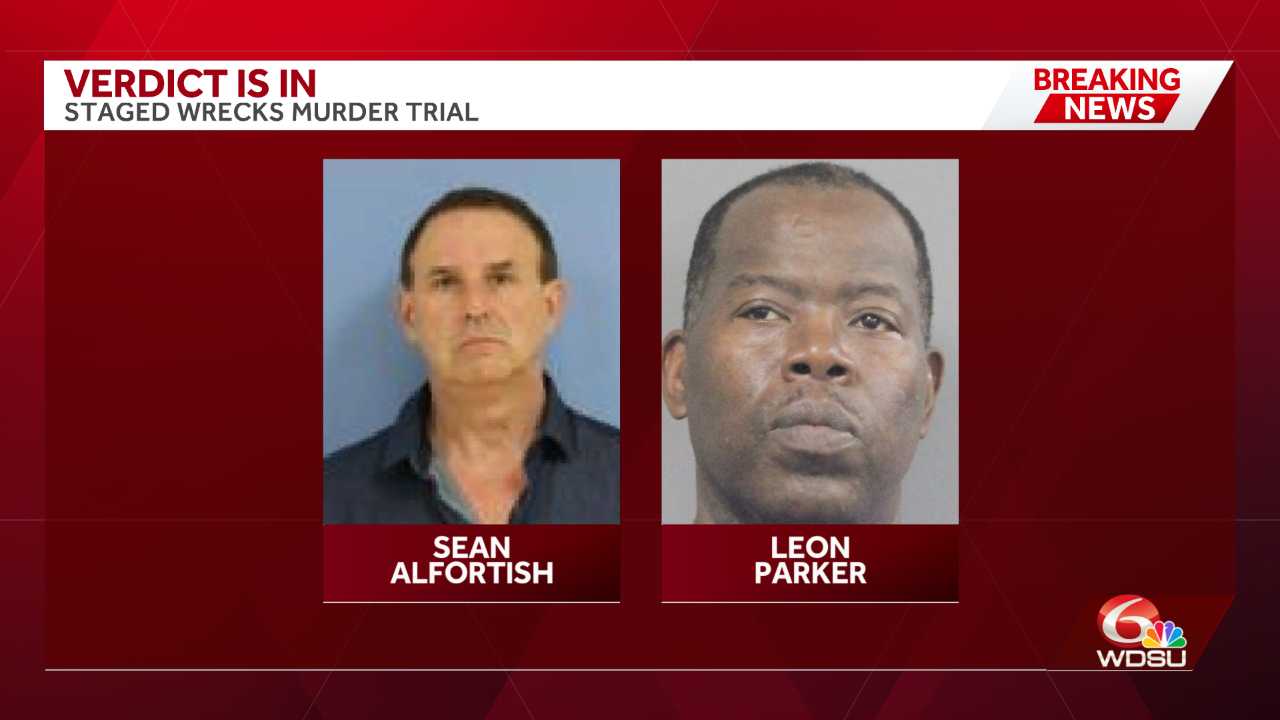
A jury has reached a partial verdict in the New Orleans staged wrecks murder trial.
Disbarred attorney Sean Alfortish and accused hitman Leon Parker were on trial for nearly four weeks related to the 2020 killing of federal witness Cornelius Garrison in the staged wrecks investigation.
Alfortish was convicted of conspiracy to commit mail fraud and wire fraud, two counts of mail fraud, one count of obstruction of justice, and witness tampering. The jury could not reach a verdict on the charges of conspiracy to commit witness tampering through murder, retaliation against a witness through murder, or causing death through use of a firearm. He was found not guilty of obstruction of justice and subornation of perjury.
The jury was unable to reach a verdict on Parker’s charges of conspiracy to commit witness tampering through murder, witness tampering through murder, conspiracy to retaliate against a witness through murder, retaliation against a witness through murder, and causing death through use of a firearm.
Garrison was killed in 2020 at the Columbia Park subdivision in Gentilly. He was cooperating with the federal government after working for years setting up staged wrecks.
WDSU first exposed the scheme in 2018; since then, 63 people have been charged and more than 50 have pleaded guilty.
Two prominent lawyers were convicted in the scheme in March: Vanessa Motta, and Jason Giles.
Prosecutors say the alleged fraud, dating back to 2011, has fueled Louisiana’s sky-high auto insurance rates, which are some of the highest in the country.
Both Alfortish and Parker are being remanded pending sentencing and a retrial.
Vitter ended the proceedings by acknowledging Alfortish and Parker directly.
“The final thing I will say and hopefully this doesn’t sound sarcastic, you had a fair trial and you were represented by excellent attorneys, and I’ll leave it at that,” Vitter said. “Can’t say I enjoyed it, but you earned my respect.”
Below is a recap of the entire trial.
Opening Statements:
Federal government’s opening statement:
The U.S. Attorney’s Office kicked off opening statements painting Alfortish and Parker as killers.
Federal prosecutors alleged Wednesday that Alfortish helped orchestrate the killing of Garrison after he agreed to cooperate with the FBI.
In opening statements, prosecutor Matt Payne described Garrison’s fatal shooting at his mother’s home as an “assassination” that was intended to derail the federal investigation into staged wrecks and warn others against cooperating.
Payne said Garrison’s last words were “Mama fell on the floor,” before dying from 10 gunshot wounds.
“They shot him at his mom’s house. They shot him 10 times,” Payne said. “That sends a message: Don’t cooperate.”
Garrison played a key role in the staged wreck scheme and was accused of staging more than 50 wrecks in New Orleans as a slammer.
Payne told jurors that Garrison would sideswipe trucks and leave the scene while a passenger moved to the driver’s seat.
The passengers would be taken to attorneys, who filed lawsuits and sought insurance settlements, according to Payne.
“That, ladies and gentlemen, is how you get paid in an 18-wheeler scheme,” Payne said.
In one example shown to jurors, a crash generated an $837,000 payout, including about $300,000 in attorney fees. Another staged collision involved a bus carrying a Loyola volleyball team and produced a $650,000 settlement.
Garrison allegedly received $85,000 from that case and was unhappy with his share, according to Payne.
Prosecutors said Alfortish, who was disbarred in 2017, paid Garrison $136,000 that year. Jurors were shown a check issued to Garrison by Affiliated Management LLC.
Payne said Garrison allegedly brought recruited passengers to Alfortish’s Kenner law office.
Prosecutors said Vanessa Motta, Alfortish’s fiancée who was convicted in the scheme, filed fraudulent lawsuits connected to the crashes. Alfortish and Motta also have a child together.
Prosecutors allege that Alfortish asked a slammer in the scheme, Ryan Harris, whether he could kill Garrison. Jovanna Gardner, Harris’ girlfriend, later became involved in arranging a meeting, according to Payne.
Payne then outlined a timeline leading up to Garrison’s death.
According to Payne, Harris, who is Parker’s stepson, allegedly tried to buy a gun.
The day before the shooting, Parker allegedly drained his bank account and met Harris in a parking lot on Crowder Boulevard. Harris also bought a burner phone, Payne said.
On the day of the killing, a burner phone was allegedly detected outside Garrison’s home. Jurors were shown a message sent from a woman’s phone that read, “Imma text you when I’m outside.”
Payne said that is when Garrison was met with gunfire at about 8:30 p.m. and was shot 10 times.
Prosecutors then showed pictures of Garrison, his body and the crime scene.
“They wanted a message to be heard through the city,” Payne told jurors.
According to Payne, attorneys representing trucking companies and insurers began questioning the claims after discovering inconsistencies. In some cases, passengers who appeared to know one another allegedly had no actual relationship.
Phone records repeatedly showed Garrison’s number, and Alfortish was allegedly in contact with him before some of the crashes, according to Payne.
The FBI began investigating, and Garrison was questioned after his October 2019 arrest on an unrelated charge. Payne called that development a “game changer,” saying Garrison agreed to help investigators and secretly record meetings.
In one undercover recording made at Clearview Mall in December 2019, Alfortish allegedly told Garrison, “If anything happens to you, we take care of you.”
Prosecutors also said Garrison was offered $500,000 and a trip to the Bahamas.
By September 2020, Payne said, “the walls” were closing in and Motta had received a subpoena.
Alfortish allegedly instructed others to lie by claiming money paid to Garrison was payment for construction work.
Payne told jurors they would hear evidence about online searches allegedly made by Alfortish, including questions about how far back the FBI could obtain emails and how far back the government could seize money following a federal conviction.
According to Payne, the staged-crash scheme continued even after Garrison was killed. Parker allegedly took part in another staged accident, and Motta represented him in a case as late as December 2021.
After Alfortish was indicted and jailed, he allegedly offered an inmate money to provide false information about Harris.
Prosecutors referenced a letter involving an inmate in Honduras that stated, “The lawyer with you, I heard he got more. Tell the boy to send the bread.”
Alfortish faces charges involving fraud, obstruction of justice, witness tampering and homicide-related offenses, according to prosecutors.
Payne said jurors are expected to hear testimony from Harris, truck drivers, recruited passengers, Garrison’s attorney and lawyers who represented trucking companies and insurers.
Passengers are expected to describe how they were recruited and taken to the offices of Alfortish and Motta, according to Payne.
Payne told jurors that Garrison’s killing stopped the federal investigation “in its tracks,” but said investigators eventually uncovered the wider operation and the alleged effort to silence him.
Alfortish’s attorney, Shaun Clarke, told jurors Wednesday that cooperating witness Ryan Harris was the mastermind behind the killing of Cornelius Garrison, and is now implicating Alfortish in hopes of receiving a lighter sentence.
Clarke said in his opening statement that any financial records or communications between Harris and Parker do not prove he knowingly participated in staged crashes or paid to have Garrison killed.
“The records prove money moved,” Clarke said. “They don’t prove why money moved.”
Clarke told jurors that Harris devised the murder plan because he had staged accidents with Garrison and feared being exposed.
“Someone wanted him dead: Ryan Harris,” Clarke said. “Harris devised the plan.”
Clarke also outlined what he claimed were communications and the exchange of money between Alfortish and Garrison, but emphasized those interactions did not prove he was part of the conspiracy.
He described Garrison as a “hustler” and claimed Alfortish sometimes gave him “hundreds of dollars to satisfy him.”
Clarke claimed that Harris and Garrison staged wrecks together, and that he had more of a motive than Alfortish in the killing.
According to Clarke, the government had gathered substantial evidence against Harris, which is why he redirected the FBI to Alfortish, describing him as an appealing target.
Clarke also pushed back on the government’s opening statement regarding Alfortish having a role in the scheme by referring clients to Motta’s law firm.
He stressed that their relationship was not a conspiracy, and said Alfortish was not involved in any of those decisions.
Clarke also touched on claims from the government that Alfortish asked an inmate he met in jail to provide false testimony in the case.
According to Clarke, the inmate was deported, and Alfortish never asked or paid for him to be deposed in the case.
“The missing links will remain; those missing links are reasonable doubt,” Clarke said. “Alfortish will be not guilty.”
Lawyer for federal witness killed testifies:
Claude Kelly, Garrison’s lawyer, took the stand as the federal government’s first witness.
Kelly testified that Garrison was a slammer in the staged wrecks scheme, and described how he would put people in cars and later disappear from the scene after the crash.
“He would cause the accident,” Kelly said. “Passengers would slide over. He was cool as a cucumber, walking out on the middle of Interstate 10, get in a car, and leave.”
Kelly said Garrison would bring passengers to the attorney’s offices so they could sue, and he would get paid per hit.
“He was frustrated with them regarding payments,” Kelly said.
Kelly said Garrison moved to working with Alfortish because he got paid faster.
“It was business,” Garrison said. “He got paid quickly.”
According to Kelly, Garrison showed a stack of checks to law enforcement that questioned him. He said the checks were from Alfortish regarding construction.
“He thought Sean Alfortish was a lawyer still,” Kelly said.
According to Kelly, Garrison got a target letter in January 2020 and learned he was going to be deposed regarding an 18-wheeler accident he was involved in for Vanessa Motta.
According to Kelly, the deposition happened with his public defender, and Alfortish was not there.
Kelly said Alfortish encouraged people involved in staged wrecks to get surgeries in order to get more money from insurance.
Kelly also testified that Alfortish’s fiancée, Motta, said in a meeting that the reaction to the wrecks was “not a big deal” and that other lawyers “were just jealous” of how many clients she had.
Kelly was then questioned by an additional attorney for Alfortish’s legal team, James Washington.
Washington asked Kelly if cooperating with the government can impact sentencing.
Kelly said yes, and that Garrison was being truthful while cooperating.
Washington also asked Kelly about Garrison’s work relationship with Motta.
“I think he had a soft spot for Motta. Alfortish was business, and he dealt with him more,” Kelly said.
Kelly said he never spoke with Alfortish, and was not sure if it was him who told Garrison to get surgery.
Court ended Wednesday with the jury hearing the frantic 911 call made by Garrison’s mother reporting her son had been shot.
Sobs could be heard throughout the courtroom as the audio played.
Sister of Cornelius Garrison testifies:
Andrea Garrison Robertson, the sister of Cornelius Garrison, took the stand to testify about the night her brother was murdered.
Robertson testified that Garrison was a “hustler” and “never wanted to get his hands dirty.”
She said after she picked him up from jail, she dropped him off at a building near the train tracks to his lawyer and said he was going to meet Vanessa Motta immediately after he was released from jail.
Robertson was asked how she knew Leon Parker.
“We grew up in the same neighborhood,” Robertson said.
She was asked to recall the night she learned her brother had died.
“Yes, I was coming back from Walmart. I was going to take a shower, and my phone rang. It was my mom,” Robertson said. “My mom was screaming; she said they killed him.”
Robertson struggled to talk through the sobbing.
Robertson was then questioned by an attorney for Sean Alfortish’s legal team, James Washington.
Washington questioned what year Garrison had been arrested and allegedly killed and if she knew if Sean Alfortish actually bonded him out.
“He told me to call Sean to bond him out, and he was released, so I’m assuming Sean bonded him out,” Robertson said.
Washington also asked if Garrison told her to take him to Vanessa Motta’s office.
Robertson stated she’s never seen Motta or Alfortish.
According to Robertson, she participated in a staged accident but didn’t know what car Garrison got into following the crash or who was driving.
She stated that, following the accident, she went to Womack Firm but doesn’t remember which attorney she spoke with, though she does recall that the attorney filed a lawsuit on her behalf.
“Yes, I didn’t get anything from it,” Robertson said.
Robertson testified that Garrison did get paid for the accident.
“That was his hustle, I guess he did,” Robertson said.
She testified that she never had to give a deposition and couldn’t remember whether the police were called after the accident or whether she gave a statement.
When asked if Garrison had any other hustles, she responded, “That’s the only thing I know of.”
Accused slammer testifies:
Accused slammer Waylon Collins took the stand during the nearly four-week trial.
Collins is accused of staging wrecks with Garrison.
Collins testified that he rode in staged wrecks and was part of a scheme where they hit an 18-wheeler.
According to Collins, Ryan Harris was the driver in that incident.
According to Collins, his pregnant wife was in the car at the time of the crash and moved to the driver’s position.
Collins testified that he was a client of Vanessa Motta’s, and that of the $400,000 insurance payout, his wife got $90,000 and Motta got the rest.
Defense attorneys for both Parker and Alfortish questioned Collins’ involvement in the scheme, specifically questioning his testimony during Motta and Giles’ trials in March, as well as his deposition with the federal government years ago.
Collins stressed to the defense that he knew he was committing fraud and was only here to tell the truth.
Collins has not been charged with a crime in connection with the scheme.
“I can be charged at any given time. I cannot say the government has been happy with my role in this case or not. I can be charged at any given time,” Collins said.
According to Collins, Motta told him he was “too far in” to back out, and that Alfortish coached him for his deposition.
Collins also testified that Motta told him to forge documents, and Alfortish told him to lie.
Collins said on the stand that he was scared and knew everything he told police was not true.
“I knew it was fraud; it’s just crazy. I’m here to tell the truth. The accident was fraud,” Collins said.
Alleged staged wreck participant testifies:
A woman by the name of “Ms. Henderson” testified that she participated in a staged wreck with Garrison.
According to Henderson, she was recruited to be a passenger in a crash where Garrison slammed into a Walmart 18-wheeler on Interstate 10 in New Orleans East.
Henderson testified that she met Garrison at a Popeyes restaurant on Paris Avenue and got into a car with Garrison and another friend.
Garrison sideswiped the truck and ran away from the scene.
According to Henderson’s testimony, she moved to the driver’s seat and called police, reporting she had an injury.
“I told them a lie,” she testified. “I told police I was driving. That was not the truth.”
Henderson said that before the crash, Garrison told her that they would visit Vanessa Motta, a convicted attorney in the scheme, and that Henderson would later undergo surgery as part of the insurance claim.
Henderson said she went home after the collision and drove to Motta’s office the following morning. Garrison was already there when she arrived, according to her testimony.
Henderson testified that she waited in a conference room until Motta entered alone and gave her documents to sign. Henderson signed a contract hiring Motta and falsely identified herself as the driver. According to Henderson, Motta did not ask where the crash happened.
Henderson said after Motta left the conference room, Alfortish entered and introduced himself.
According to Henderson, she understood that he worked with Motta and that he knew Garrison.
Henderson became emotional on the stand when describing her medical procedure linked to the crash.
She said at the time, all she was thinking about was the money, since she was told the procedure would increase the amount of money she could receive.
According to Henderson’s testimony, she did not believe the procedure was medically necessary, and said Motta arranged the appointment for her.
Henderson also testified about her last conversation with Garrison before he died.
According to Henderson, she and her husband visited Garrison at his home before traveling to a Saints game out of town.
Henderson said Garrison told her Motta and Alfortish were angry at him and wanted him to leave.
Henderson also testified that Garrison complained he hadn’t received money he was owed, and that he planned on cooperating with a federal investigation.
Henderson said she found out about his death while she was out of town.
When federal investigators reached out to her about a year ago, Henderson said she was “scared to death.”
“I was afraid someone would hurt me or my family,” Henderson testified.
According to Henderson, she has not been charged and stressed that she has been truthful about her involvement in the scheme.
Alfortish’s CPA testifies:
Alfortish’s CPA Roxanne Galliano took the stand, detailing thousands of dollars paid out from a trust set up by Alfortish.
According to Galliano, Alfortish has been her client since 1990, and she did his books as recently as 2024.
Galliano testified that a trust was set up on Feb. 8, 2017, for his daughter.
According to Galliano, $304,000 was deposited into the account, and payments were made to several people through the account.
Some of those payments ranged from $3,000 to $75,000, according to Galliano.
“He just collected cases, distributed them to attorneys, and he got paid for it,” Galliano said.
Galliano testified that she did Alfortish’s taxes in 2016 and was given passwords and logins for bank accounts.
Galliano testified that she didn’t like how the trust was structured, that it was supposed to be used for a child and not as a business.
According to Galliano, he wasn’t selling any products but was generating a million dollars in a year.
She testified that for tax purposes, she had to list his services as marketing.
According to Galliano, Alfortish stopped writing checks in 2018.
Ryan Harris testifies to plotting murder of federal witness
One of the federal government’s star witnesses gave bombshell testimony during the nearly four-week trial.
Ryan Harris, the stepson of accused hitman Leon Parker, admitted that he, Parker and disbarred attorney Sean Alfortish plotted to kill federal witness Cornelius Garrison.
Garrison, a slammer for Vanessa Motta, a convicted attorney in the scheme and Alfortish’s fiancée, cooperated in the government’s probe into the scheme that defrauded insurance companies of millions of dollars.
Harris testified that Garrison’s cooperation with federal investigators led to the three plotting to kill him.
Harris outlined on the stand the preparations he said involved Alfortish, Motta and Parker.
Harris, who entered the courtroom in a red jail uniform and restraints, has pleaded guilty to charges related to the staged wrecks and his involvement in Garrison’s 2020 killing.
He faces up to life in prison and acknowledged that he hopes his cooperation will result in a reduced sentence.
Harris told jurors the government had not instructed him what to say and that he intended to tell the truth.
Harris describes staged-crash operation
Harris testified that he and Garrison participated in more than 30 staged wrecks, many of those involving 18-wheelers.
Garrison would drive and intentionally strike trucks, while Harris said he would recruit passengers and sometimes act as a “spotter” who followed the crash vehicle.
According to Harris, Garrison and staged wreck participants would meet at a Burger King near Louisa Street and Gentilly Boulevard before a crash.
Harris testified that after the crashes, he would pick up Garrison after he walked away from the scenes.
Harris testified that he sometimes attended meetings between the passengers and Motta to make sure participants gave similar stories.
According to Harris, Alfortish also attended some meetings.
According to Harris, Motta and Alfortish knew the crashes were staged.
Harris alleged that he and Garrison were paid $1,000 for every passenger involved in an 18-wheeler collision. In some instances, Alfortish wrote checks for between $3,000 and $4,000 after the group delivered clients to the office, Harris said.
Harris testified that he and Garrison discussed completed and planned crashes openly with Alfortish.
Scheme shifts away from commercial trucks
Harris also testified about when the federal government began investigating the staged wrecks with 18-wheelers.
“The feds were getting hot,” Harris testified. “They were cracking down on the 18-wheeler crashes after they saw a pattern.”
Harris testified that he warned Motta that the group needed to stop staging truck crashes.
Harris said he then shifted to car-to-car collisions in New Orleans East, including near Bullard Avenue, Bundy Road and the Interstate 10 service road.
According to Harris, he told Motta in advance that those crashes were staged and brought participants to her office afterward.
He alleged that Motta told Harris to obtain insurance policies with high bodily-injury coverage limits.
Harris also claimed Motta encouraged him to undergo surgery for a Liberty Mutual claim, even though he did not believe he was injured.
“I was doing it for the money, not because I was actually hurt,” Harris testified.
Burner phones allegedly used to avoid detection
Harris told jurors that he used disposable burner phones when communicating with Parker and Alfortish.
He described a burner phone as an unregistered phone that could be broken and discarded after use.
“We just didn’t want our number to be on the State Farm call log,” Harris said.
Harris also testified that Motta preferred FaceTime because she believed federal investigators could not track the calls.
After Garrison’s death, Harris said he continued bringing staged wreck cases to Motta. During one conversation, Motta allegedly passed him a note warning that their discussion was being recorded.
“She said she was doing that to protect herself,” Harris testified.
Harris outlines murder plot
Harris testified that Alfortish feared Garrison would disclose information about the scheme to the feds.
According to Harris, his mother learned Garrison was cooperating and discussed it while his stepfather, Parker, was present.
Harris said Parker called Garrison a “rat” and threatened to kill him.
Harris also described a FaceTime call with Motta during which she told him Garrison had been indicted.
“She was hollering and crying and all over the place,” Harris said.
Harris then testified about a conversation in which Motta, Alfortish and Parker discussed Garrison as a threat for cooperating with the feds.
During that conversation, Harris alleged, Alfortish called Garrison a racial slur and a “rat” before asking whether Harris knew anyone who could kill him.
Harris testified that he had never killed anyone.
“Sean was pissed off, like he had had enough and would do something about it,” Harris testified.
According to Harris, Alfortish and Parker both wanted Garrison killed. Harris alleged that Motta was in the room during that conversation.
Harris details preparations before killing
Harris testified that he arranged a meeting between Alfortish and Parker outside Harris’ automotive shop in Metairie.
He later met Parker at a Planet Fitness in New Orleans East.
According to Harris, Parker said he “got everything he needed” and was “ready to kill” Garrison.
Harris said he purchased burner phones, including one that Jovanna Gardner, his girlfriend and the mother of his child, used to contact Garrison under the name “Kim.”
“I told her me, Sean and Leon needed her to text Cornelius so he would come out and we could talk to him,” Harris testified.
Harris maintained that Gardner did not know Garrison was going to be killed.
Harris said Parker told him to go to Garrison’s home to check for security cameras.
“I was just making sure that we would have no issues like video surveillance and cameras,” Harris said during his testimony.
Harris said he met Parker again the following day, after Parker’s wife dropped him off. They traveled to the Wind Run Apartments in New Orleans East, where Parker allegedly had a stolen vehicle, according to Harris’ testimony.
“That’s the car he was going to murder Cornelius in,” Harris said on the stand.
According to Harris, Parker wore black clothing, gloves and a beanie, which could be rolled down like a ski mask. Harris also said Parker had a 9 mm handgun with an extended magazine.
Harris testified that he then went home.
Harris says Parker admitted to killing Garrison
An hour after the shooting, Harris said he went to pick up Parker from the apartments and said Parker admitted to him that he killed Garrison.
“He told me he killed him, said, ‘I got him,’ and was kind of excited about it,” Harris testified.
Harris said the burner phones were destroyed and the gun used to kill Garrison was thrown into a canal.
In 2025, Harris went with FBI agents to the area to search for the weapon.
Harris also testified that Parker claimed Alfortish had paid him after the killing.
“He said Sean paid him, that he got paid,” Harris said.
Harris testified that he did not know how much Alfortish paid him or how.
Harris said he later told Gardner that Parker killed Garrison and warned her to remain silent.
“I told her Leon killed him, and I told her not to say nothing, that this could get us killed,” Harris said on the stand.
Harris said Gardner was angry when she learned what had happened.
The prosecution asked Harris what his role was in the killing of Garrison.
“Helping out and introducing Leon and Sean to each other. Me, Leon and Sean did it,” Harris said.
The prosecution took a break for lunch, and the defense is expected to begin questioning Harris Tuesday afternoon.
Defense questions Harris’ credibility:
Alfortish’s attorney Shaun Clarke opened up his questioning for Harris by asking him if he was a murderer.
“No sir, I helped, but I’m not a murderer,” Harris said.
Clarke showed Harris that the charges he faced were death penalty eligible, but that the government didn’t seek the death penalty.
Harris told Clarke that he was testifying in hopes of receiving a lighter sentence, but that nothing was guaranteed.
“You participated in killing someone to stay out of jail, so lying should be nothing to you, right?” Clarke asked Harris.
Harris responded that he was there to tell the truth.
“The person who had the most to gain from Cornelius’s death was you, correct?” Clarke asked.
“We all did,” Harris responded.
Clarke also pressed Harris about the staged wrecks. Harris told Clarke that he worked with Motta and the King Firm, and that Motta recorded calls after Garrison was killed.
“It was part of our plan to say yes, the accidents were real,” Harris said.
Clarke then asked if he killed someone to stop the scheme from coming down on Harris.
“Yes, I helped out,” Harris said.
Clarke then played recorded calls with Motta where he tried to show a pattern of Harris lying. The call showed Motta asking him about staging wrecks, and Harris saying they weren’t staged.
Clarke then asked Harris about destroying evidence connected to the murder.
“You obtained gasoline and poured it in the vehicle, and then you ignited it, correct? You destroyed the burner phones, correct?” Clarke asked.
Harris admitted to both of those things.
Clarke then asked Harris if he threatened to kill Gardner, his girlfriend, if she said anything.
“No, I said do not say anything – Leon killed Cornelius, and we could get killed if you say anything,” Harris said.
Clarke questioned Harris on whether the federal government helped prepare him for his testimony.
Harris said yes, that the meetings he had with the federal government were long.
Clarke also asked Harris if he ever saw any evidence of Alfortish paying Parker for the killing.
Harris testified that he didn’t have a text or email from Alfortish saying to kill Garrison, but that Parker told him that he was paid to do it.
“I just know he paid him, Leon told me he paid him,” Harris said.
Secret recordings played in court:
An FBI agent testified about secretly recorded conversations involving disbarred attorney Sean Alfortish and killed federal witness Cornelius Garrison.
FBI agent Robert Orvin told jurors that Garrison, who was cooperating with investigators, recorded phone calls and an in-person meeting with Alfortish.
Investigators concealed a camera and a microphone in Garrison’s key fob.
The jury watched video of a meeting at a local mall.
In the recording, Alfortish allegedly told Garrison he would work to get him a lawyer. He also appeared to suggest what Garrison should say about construction work at his fiancée Vanessa Motta’s home.
“Say you did construction in 2017 at Vanessa’s house, my momma’s house,” Alfortish said in the recording. “I’m saying you did the work there.”
“I just want it over with,” Garrison responded.
Garrison later said, “When all this s— is over, I am gone.”
During questioning, Alfortish’s attorney, Shaun Clarke, asked Orvin whether Alfortish had offered to move Garrison to the Bahamas and pay him $500,000 to “go away.”
Orvin said yes.
Orvin also said investigators pursued the recordings even though the investigation was already public.
“This case was overt from the beginning, so I don’t think they would say it out in public, but we figured taking the chances of getting some recordings would be beneficial to the case,” Orvin said.
Alfortish’s attorney later asked that another recording be played and questioned Orvin about whether Alfortish made any directly incriminating statements.
In that recording, Garrison showed Alfortish a subpoena.
“They’re just going to ask you about the case,” Alfortish said. “They are trying to make you out to be the worst conspirator in the world.”
“So, this is not serious?” Garrison asked Alfortish.
“No, no, it’s civil,” Alfortish responded. “They’re just trying to be cute.”
Clarke said Alfortish was sent subpoenas and that he turned over what he had to the FBI, including records from other attorneys who worked with Motta.
Orvin testified that Alfortish failed to respond to ” any and all” subpoenas.
The attorney for the co-defendant in the case, Leon Parker, asked Orvin about news coverage of the scheme, including investigations done by WDSU.
The agent was shown a WDSU investigation from 2020.
Orvin testified that he was at the scene of Garrison’s shooting.
Jurors also heard testimony about payments that prosecutors allege Alfortish hid from investigators, along with banking records detailing changes made to his family trust.
During redirect examination, prosecutor Matt Payne questioned Orvin about subpoenas seeking records connected to 21 allegedly fraudulent cases. The agent testified that cooperating witness Garrison provided investigators with information about Alfortish.
The agent also testified that cases handled by Motta and another attorney, who worked in the same building, were referred to them by Alfortish.
Payne asked whether payments to people allegedly involved in collusion should have been included in records produced under subpoena.
Orvin said yes.
Prosecutors also presented evidence they claim shows Alfortish continued to hide payments to Garrison and others after an initial subpoena was issued.
The jury again watched a roughly three-minute video of a December 2019 meeting between Alfortish and Garrison at Clearview Mall. The two appeared to speak indirectly while discussing the investigation.
The agent characterized Alfortish’s conduct during the meeting as an effort to “gain control of Mr. Garrison.”
At one point in the recording, Garrison said, “I’m dead on the streets,” after receiving a subpoena and learning that cases had been stayed.
The agent also discussed investigators’ interviews with passengers in allegedly staged crashes.
“When we told them, ‘Did you know you were worth $1,000?’ it shocked them,” Orvin said on the stand.
Bank manager details changes to trust
The government’s next witness was Judy Breaux, a deposit services manager at Home Bank.
Breaux, who lives in New Iberia, testified that she has worked for Home Bank for 11 years and has approximately 45 years of banking experience.
Breaux said she helped respond to a federal grand jury subpoena issued to the bank in connection with the investigation.
She testified about records involving the JA Trust, which was created on July 7, 2015.
According to Breaux, the trust documents named Sylvia Alfortish and A.T. Mathis as trustees and were signed by Sean Alfortish, Sylvia Alfortish and Mathis.
The trust listed an address on Driftwood Boulevard in Kenner.
Breaux testified that Sylvia Alfortish, Sean Alfortish’s mother, went to Home Bank on Feb. 5, 2020, seeking to open a checking account for the trust.
Bank officials denied the request because Sylvia arrived alone and the original agreement did not allow one trustee to act independently.
Two days later, Sylvia returned with an amendment to the trust, according to Breaux.
The amendment removed Mathis as co-trustee, designated Sylvia as the investment trustee and allowed her to act on the trust’s behalf without another trustee.
According to the testimony, Sean Alfortish signed the amendment. Lionel Sutton, who worked in a building owned by Alfortish, notarized the agreement. Mathis used a Nevada notary to authorize his removal from the trust, according to Breaux’s testimony.
Breaux testified that the account was closed on Aug. 17, 2022. Sylvia signed on behalf of the trust and withdrew its remaining balance of $778.16.
After the government completed its questioning, Alfortish’s defense attorney focused on Home Bank’s procedures and how it responded to the subpoena.
Prosecutors then briefly questioned Breaux again on redirect before she was released from the witness stand.
WDSU Investigates obtains video of staged wreck involving bus carrying Loyola volleyball team
Newly obtained video shows a 2015 staged wreck connected to the murder of federal witness Cornelius Garrison, who was killed in 2020.
The video, obtained by WDSU Investigates, shows a bus carrying the Loyola volleyball team and a silver car moving slowly.
The bus driver shifts lanes twice before the crash, which involved a silver car and a red car.
Investigators allege that Garrison was in the silver car acting as a “slammer,” someone who intentionally causes crashes.
The case settled for $650,000, and Garrison underwent surgeries following the crash.
Garrison’s former girlfriend testified Wednesday, sharing details about their relationship, which began after her lawsuit was filed in August 2018. She said they later lived together.
“I figured he did collisions for a living. I would have to pick glass out of his hair,” she said. “He said I have to go see the lawyers in the morning. He was going to Vanessa and Sean.”
Garrison eventually began cooperating with investigators but was murdered in 2020.
Vanessa Motta, an attorney involved in staged wrecks that led to significant payouts, has already been convicted for her role.
An attorney testified that Garrison was linked to at least 50 crashes. Disbarred attorney Sean Alfortish and Leon Parker are accused of being tied to his murder.
Doctor testifies on health of man accused of gunning down federal staged wrecks witness
Dr. Lawrence Counts took the stand and testified that accused hitman Parker underwent a commercial driver’s license physical examination just days before Garrison was killed and showed no apparent signs of neck, back or mobility problems.
Counts said he evaluated Parker on Sept. 9, 2020.
According to Counts, Parker reported no neck or back issues on a medical questionnaire and completed the physical exercises required during the examination, including squats.
Counts said Parker was taking amlodipine, a medication used to treat high blood pressure. Parker also reported undergoing gastric-sleeve surgery in December 2019 and losing approximately 100 pounds.
According to Counts, Parker’s weight was the only notable physical concern. The testimony included differing references to Parker weighing either 289 or 298 pounds at 5 feet, 10 inches tall.
During cross-examination, Parker’s attorney asked whether a body mass index of approximately 42.8 would be considered severe obesity. Counts responded that it might be.
Parker’s attorney also questioned the length of the examination, asking Counts whether his testimony on the witness stand had lasted longer than his exam of Parker.
Counts said that was possible and estimated the exam took about 15 minutes.
He also testified that he had performed at least 500 to 600 commercial driver examinations. According to Counts, the evaluations are intended to determine whether drivers can safely operate commercial vehicles without posing a risk to the public.
The examinations include checking whether a driver has enough strength to turn a steering wheel, can turn their head adequately to see, and can safely enter and exit a vehicle. Counts said he requires patients to perform mobility exercises in front of him so he can directly evaluate their abilities.
Counts said he practiced internal medicine and hospital medicine before moving into administration. He said he worked at Concentra Urgent Care in New Orleans’ Central Business District, where occupational health services included commercial driver evaluations.
Before Counts took the stand, jurors heard from an FBI cellphone data specialist who corroborated cellphone evidence used in the case.
An insurance defense attorney also testified about litigation involving Vanessa Motta while the attorney represented a trucking company.
Jailhouse informants testified in New Orleans staged wrecks murder trial
Jurors heard testimony from two jailhouse witnesses about conversations and relationships connected to Alfortish and Ryan Harris.
Harris has been convicted for his role in the murder of Garrison and for staging wrecks. Harris was sentenced to prison for a duration that doesn’t exceed 40 years.
Mark Fridge, who is currently being held in Lafourche Parish, testified about what he described as a close, “father-son” relationship with Alfortish.
Fridge testified to a three-way phone call from July 2025 where he said Alfortish was “stressing.”
He also testified about receiving commissary money and other favors that Fridge believed were intended to gain his loyalty.
During questioning, Fridge confirmed that he had been interviewed by the government in connection with the case. He said Alfortish had always maintained his innocence, a claim Fridge described as “nauseating.”
Jurors also watched a video deposition recorded in September 2025 featuring Cesar A. Lobo-Ramos, who testified through an interpreter while facing deportation to Honduras.
Alfortish was present during the deposition, along with his attorney, Shaun Clarke, and attorneys representing Vanessa Motta and Jason Giles, who both have been convicted in the scheme.
Lobo-Ramos said he was housed in the St. Tammany Parish jail from March to October 2024 after initially being held in Jefferson Parish. He testified that he overheard conversations involving Harris, whom he said other inmates called “Red.”
According to Lobo-Ramos, Harris said he needed to get out of jail and was “not going down” and would be free. Lobo-Ramos also claimed he heard Harris discuss setting up a white man to secure his release.
Lobo-Ramos said the conversation took place among a group of inmates who were approximately 10 feet away. When asked whether Harris was the person speaking, Lobo-Ramos responded, “It was him.”
After being transferred to the St. Charles Parish jail in October 2024, Lobo-Ramos said he met Alfortish and told him about the alleged conversation.
“I told Alfortish I would tell the truth,” Lobo-Ramos said.
Prosecutors questioned Lobo-Ramos about why he did not report the alleged statements when he first heard them. He acknowledged that he never contacted police, the FBI or other authorities and did not disclose the information until months later, after meeting Alfortish.
Prosecutors also noted that Lobo-Ramos later met with Sean Toomey, an attorney for Motta.
When pressed for details about what Harris allegedly said regarding staged wrecks, Lobo-Ramos called it “just a word I overheard,” but maintained that Harris made the comment.
Lobo-Ramos denied being promised anything or threatened in exchange for his testimony.
Prosecutors also questioned him about his criminal history. Lobo-Ramos was convicted of sexual battery in Jefferson Parish in 2011, removed from the United States in 2018, and later convicted of illegally reentering the country. At the time of the deposition, he was expected to be deported again to Honduras.
Another jail informant, Derek Franklin, testified that he was in jail with Parker in St. Tammany Parish.
Franklin testified that Parker admitted to him that killing Garrison was “a professional hit” and that a lawyer offered him $100,000 to do it.
According to Franklin, Parker told him he “would have gotten away with the murder of the century” and that it was the biggest case in New Orleans.
Franklin testified that Parker also was involved in staged wrecks, and that he could get more money if a doctor cut into him.
According to Franklin, Parker also claimed to have back pain and that his medical records would “help him beat the murder.”
Franklin said on the stand that he never saw Parker take any medication in jail for back pain.
FBI outlines money trail, burner phones, and search for gun tied to murder
The jury heard from an FBI forensic accountant who testified that she combed through hundreds of thousands of financial records that revealed payments to alleged participants in the scheme.
Lisa Ferrara testified that she reviewed bank, investment, retirement, cryptocurrency, personal and business records spanning more than a decade that were linked to Alfortish, Affiliated Management, the JA Trust and Leon Parker.
Investigators reviewed Alfortish’s accounts at eight banks from March 2012 through December 2024, she testified.
Ferrara testified that money was moving in and out of multiple accounts.
According to Ferrara, she traced deposits in the account linked to Affiliated Management, which is a company tied to Alfortish.
She said that deposits increased from about $91,000 in 2015 to $306,000 in 2016.
According to Ferrara, in 2017 there was more than $800,000 in the account. By 2018, deposits had reached $1.4 million.
“Then, it skyrockets,” Ferrara said on the stand.
About 25% of the 2018 deposits came from Alfortish’s fiancée, Vanessa Motta, according to the testimony. Memos on checks included terms such as “loans,” “advances” and “advertising,” as well as the names of plaintiffs in crashes prosecutors allege were staged.
Ferrara said Garrison began receiving payments in May 2017. Affiliated Management’s payments to him stopped in May 2018, around the time insurance companies began raising the red flag on the claims.
Deposits into Affiliated Management fell significantly in 2019, and its bank accounts closed in 2020, which was the year Garrison was killed.
According to Ferrara, Affiliated Management made 188 payments totaling $406,750 to people prosecutors identified as “slammers” and “spotters.”
The terms refer to people accused of causing staged wrecks or recruiting participants.
Some payments were issued on the same date. Records also showed payments to Garrison on Aug. 10 and Aug. 16, 2017, each one day after a collision, according to Ferrara’s testimony.
From 2015 through 2020, Affiliated Management paid approximately $295,000 to Alfortish, $279,000 toward an Alfortish American Express account and $194,000 to Garrison, according to Ferrara.
A construction contractor received about $59,000, and the company contributed to expenses associated with Motta’s home, Ferrara said.
She also described JA Medical Management as an entity used to pay medical expenses associated with injuries from wrecks.
After 2019, Alfortish’s business activity shifted from Affiliated Management to the JA Trust, which had been established for his daughter, according to Ferrara.
“The JA Trust served as an umbrella,” she said on the stand.
Her presentation traced money from the sale of a property at 525 Clay St., which brought in more than $200,000. Ferrara described the property as a location where Motta and Alfortish operated and where alleged slammers and spotters brought plaintiffs.
Ferrara also discussed differences between original trust documents held in a Fidelity account and documents later presented to Gulf Coast Bank. Prosecutors said the documents were altered to make the trust appear able to operate as a separate business entity.
Ferrara’s testimony also focused on a property at 4936 Newlands St. A $204,000 cashier’s check was used in connection with its purchase.
“Within the trust, Motta and Alfortish appear to go in together to purchase a property,” Ferrara said.
Between September and November 2020, Alfortish’s mother, Sylvia Alfortish, wrote JA Trust checks to herself and cashed them at a bank teller, Ferrara testified. The checks totaled $30,200 and were reportedly connected to the Newlands property.
The property sold for more than $300,000 in December 2020, with Sylvia Alfortish listed on the closing documents. The proceeds entered the JA Trust account, and Motta later received $100,000 from the trust, according to Ferrara’s testimony.
WDSU spoke with Alfortish’s mother outside court about the checks. She said she just did what her son told her to do.
Ferrara separately reviewed Parker’s financial accounts, including money from crashes prosecutors said were staged.
According to Ferrara’s testimony, $837,000 was awarded from a settlement tied to a crash on Jan. 17, 2016.
His attorney fees totaled about $300,000, according to Ferrara. Parker received $100,000.
Ferrara said Parker withdrew $39,000 in cash the day before Garrison was killed. Another account showed a withdrawal of more than $8,000.
According to Ferrara, she did not see a cash withdrawal of that size anywhere else in Parker’s financial records and called the withdrawal “very unusual.”
She testified that she did not find evidence of large deposits from Alfortish into Parker’s accounts.
About six months later, Parker received a $20,365 Paycheck Protection Program loan after identifying himself as a self-employed painter and reporting $100,315 in business receipts, according to a court filing.
An IRS transcript reportedly showed no 2020 tax return on file.
Parker also received disability payments, and his bank records showed a deposit of about $48,000 in July 2020.
Two other deposits were made from PPP funds, including $30,144 from Teshana Jones and a $34,256 cashier’s check tied to another crash prosecutors said was staged.
Ferrara also analyzed records from a March 2021 crash involving Parker’s wife and another witness as claimants.
According to Ferrara, each received about $30,000. Parker’s wife transferred her share to his account, while the other claimant directed most of her proceeds to Parker through a cashier’s check and kept $2,000, according to her testimony.
Ferrara said Motta represented Parker in another crash in December 2021, and said he received more than $46,000.
Alfortish’s and Parker’s attorneys cross-examined Ferrara, saying the records did not prove guilt.
FBI special agent Michael Heimbach also took the stand and testified to how difficult the investigation was in the early stages of Garrison’s murder probe.
Heimbach said investigators reviewed surveillance footage and collected location data but still struggled to develop credible leads.
Heimbach said he has served as the lead agent on the homicide investigation for the past four years.
He described an investigation that eventually focused on burner phones, firearm-related messages and communications involving Ryan Harris and Parker.
Heimbach said the NOPD first responded to the scene in the 1500 block of Foy Street the night of the killing. That’s when the NOPD later notified the FBI.
According to Heimbach, agents canvassed the neighborhood for witnesses and surveillance video. Investigators also reviewed footage from the city’s Real-Time Crime Center.
“The victim’s mother described a vehicle in her 911 call,” Heimbach said. “However, Mrs. Garrison was unable to provide a description of a suspect.
Investigators later obtained several warrants searching for electronic evidence, including a Google geofence warrant intended to identify devices near the crime scene.
They also collected cell tower records and used an address-search warrant to determine whether anyone had searched online for the location of the crime.
“There were no credible leads from those warrants,” Heimbach said during his testimony.
Investigators collected DNA swabs from the victim’s body, a doorknob and shell casings. The casings were submitted to NOPD for analysis, but those also did not produce an immediate lead.
“Every time a firearm is fired, those casings have unique markings,” Heimbach said. “Think of it like a fingerprint.”
The investigation shifted after agents examined Garrison’s phone records. Those records indicated Garrison had arranged to meet a woman at approximately 8:30 p.m. the night he was killed.
Heimbach said investigators identified a device referred to as “Burner Phone 1,” which had communicated with Garrison.
According to his testimony, the phone had contact with only two people: Garrison and one other person.
The phone was purchased at a Family Dollar in New Orleans East on Sept. 21, 2020, which was one day before Garrison was killed.
Heimbach said investigators later obtained surveillance footage of the purchase.
The FBI alleges Harris purchased the burner phone after exchanging messages with Parker on Sept. 22.
In those text messages, Parker wrote, “I am here,” and Harris responded, “Pulling up.” In another exchange, Harris wrote, “Ima be there around 7:30.” Parker asked, “Same spot,” and Harris replied, “Yea.”
Heimbach said a second burner phone was purchased on Aug. 26, 2020, at 1:41 p.m. According to Heimbach’s testimony, the device was associated with a staged wreck that month and was also linked to Harris.
Harris was arrested in November 2020. Investigators determined that a license-plate reader had recorded his Jeep Gladiator near Garrison’s house, according to Heimbach’s testimony.
Searches of Harris’s apartment produced electronic devices, ammunition and financial records. At his mother’s home in Slidell, investigators found a sweatshirt that Heimbach said resembled the one he wore in the surveillance footage.
Investigators also found 9 mm ammunition at a business on Cleary Avenue that was described in the testimony as matching evidence from the crime scene.
According to Heimbach, a search warrant for Harris’ iCloud accounts uncovered messages that appeared to arrange meetings through a burner phone, including meetings on the night before Garrison’s murder.
The records also included discussions about a car and a gun Harris was trying to buy, according to Heimbach.
An image recovered from the account showed Harris holding a gun.
Messages between Harris and Parker referred to a “Scorpion,” described during the testimony as the firearm’s make or type.
“Man that thing nice almost look like mine(s) how much,” Parker wrote in one message.
“$1,000,” Harris responded.
“Let me know when you get your hands on that thing,” Parker wrote.
Harris ultimately wasn’t able to purchase the gun, according to Heimbach.
Heimbach called the exchange an important lead because it showed Harris discussing a gun with someone near where the killing happened.
Heimbach said investigators obtained Google records associated with Parker, including data connected to the email address bigboycowboy55.
Before the homicide, Heimbach testified that the account was used to search several variations of the name Cornelius Garrett, according to the testimony. One search for “Corlinus Garrett” occurred at 3:24 p.m. on Sept. 6, 2020. A search for “Cornelius Garret” and two other similar searches were conducted the same day.
Investigators also reviewed Parker’s financial records, which showed significant bank withdrawals on the day before the killing.
Defense attorneys scrutinized the FBI’s investigation into Garrison’s murder, focusing on guns connected to Ryan Harris and what they say was a lack of forensic evidence tying Alfortish and Parker to the killing.
Parker’s attorney, Richard Schroeder, described Harris’ arrest as a significant development in the investigation. During cross-examination of Heimbach, Schroeder questioned why investigators did not conduct ballistics testing on a 9mm handgun reportedly recovered from Harris’ vehicle.
“Was that an oversight?” Schroeder asked.
“We could have done that,” Heimbach said.
The defense also questioned the FBI’s decision not to record interviews with Harris.
According to court testimony, investigators recovered a 9 mm handgun and a magazine containing 16 rounds from Harris’ vehicle on Nov. 19. Ammunition was also reportedly found at his home. Additional guns, cartridges and magazines were recovered from a business identified as Harris Motors or Network Motors on Cleary Avenue in Metairie.
Schroeder, wearing blue gloves, opened evidence bags and displayed ammunition, magazines and a Glock case to jurors. A .40-caliber shell casing was also introduced.
“Is it fair to say Harris had access to the weapons?” Schroeder asked.
“Yes,” Heimbach said.
Heimbach testified that investigators could not determine from available records that Harris purchased a gun. Defense attorneys also addressed allegations that Harris purchased burner phones, gave them to his girlfriend and burned a vehicle allegedly linked to the murder.
Jurors were then shown a picture of a canal near Gannon Road and the Interstate 10 Service Road. A dive team searched the canal and recovered two guns, but investigators determined that neither was connected to Garrison’s murder.
“We were not able to find the firearm in that canal,” Heimbach testified.
An attorney for Alfortish, James Washington, stated that the gun tied to the murder was “the most important piece of the puzzle.”
Schroeder highlighted what he described as major gaps in the government’s case.
He said there is no video of the crime and no DNA, fingerprints, footprints or blood evidence connecting Alfortish or Parker to the killing of Garrison.
He also said no witness identified them as the killers, and that Garrison’s mother only told investigators that she saw a black vehicle.
“In this case, we don’t have any video of the crime,” Schroeder said.
The defense also challenged the FBI’s handling of Garrison before his death.
Schroeder questioned why Garrison was not placed in protective custody. Heimbach could not explain why that did not happen.
Schroeder described Garrison as a prolific participant in staged wrecks, and argued that many people in New Orleans feared becoming implicated.
He then asked Heimbach if searching for Garrison’s name online to determine whether he had appeared in the news would not, by itself, make someone a murder suspect.
“Correct,” Heimbach said.
Prosecution calls last witness:
The prosecution called its last witness, FBI Agent Brandon Brown, to the stand on Thursday, Aug. 27.
Brown testified about phone records and payments presented as evidence in the staged wrecks case.
Defense attorneys for Parker and Alfortish challenged whether those records directly connected them to the scheme.
Brown testified to call logs involving Cornelius Garrison, Alfortish and Ryan Harris, as well as checks issued to Garrison.
Brown said Garrison told investigators that he staged accidents. According to Brown, Garrison often received checks shortly after the wrecks, usually the next day.
Brown said Garrison told him he regularly communicated with Alfortish.
The defense argued that phone records show only that two devices connected, not who was using them or what was said during those calls.
The defense also argued that Vanessa Motta, Alfortish’s fiancée, used his phone to contact Garrison.
Brown acknowledged that investigators did not have recordings of the calls.
The defense also argued that Brown did not cite forensic evidence for five of the 10 staged wrecks mentioned in court, and that other calls appearing in the records were not included in the government’s summaries.
Brown said the exhibits were intended to summarize the evidence for jurors. Brown maintained that the call records and checks were forensic evidence that corroborated Garrison’s story.
“He wasn’t doing accidents just to be doing them,” Brown testified. “He was doing them to make money off of them.”
During follow-up questioning, prosecutors asked Brown whether investigators had found forensic evidence supporting what Garrison told them.
“Yes, sir,” Brown said on the stand.
Brown also described Garrison as important to the investigation because he knew other attorneys allegedly involved in the operation.
“Without him, our investigation stalled,” Brown said.
Defense calls first witness:
The defense called its first witness, Dr. Chad Domangue, who is a neurologist who treated Parker for years.
He testified about Parker’s chronic back and leg pain.
Domangue, who is a double board-certified neurologist, said he began treating Parker in 2018 after he had already visited several physicians and undergone spinal-fusion surgery.
Domangue testified that patients can continue to experience pain following fusion surgery.
The defense then showed X-rays of Parker’s neck and lower back, including a December 2019 image showing the fusion, an artificial disc, and a spinal cord stimulator implanted by Domangue for pain management.
According to Domangue, the spinal segments above Parker’s fusion had started to deteriorate.
“Even with a stimulator placed, he still has back pain. He still has leg pain,” Domangue said on the stand.
Domangue said he treated Parker for approximately five years. Parker initially took hydrocodone and was later prescribed Percocet three times a day, according to Domangue.
Domangue said he never saw any indication that Parker was abusing his medication.
Medical records also described Parker as significantly overweight, at nearly 300 pounds. One examination described him as having a “slightly antalgic,” limping and slow gait.
The defense also questioned Domangue about Parker’s commercial-driver health history form that showed him not having any neck or back problems.
Domangue said Parker was likely not the first patient to provide false information on those forms to keep a job.
During cross-examination, prosecutors focused on Parker’s medical reports.
Prosecutors displayed a medical note dated Jan. 17, 2016 where Parker reported that he was driving on a highway when a semitruck hit him.
“He lied to you,” the prosecutor said.
“I don’t know the details, but I’m understanding it was a staged accident,” Domangue said on the stand.
Domangue also testified that he was not aware of the amount Parker received through a settlement.
“By convincing you he needed a stimulator, he was able to increase his settlement,” the prosecutor asked Domangue.
The defense stressed that Domangue continued treating Parker after the settlement was reached.
Defense rests:
Alfortish’s legal team rested Thursday, and Parker’s attorney called one witness Friday morning.
Parker’s attorney called Jovanna Gardner, Ryan Harris’ former girlfriend.
Harris has been convicted for his role in the murder of Garrison and for staging wrecks. Harris was sentenced to prison for a duration that doesn’t exceed 40 years.
During his testimony, Harris admitted to helping plot the murder of Garrison, but denied being the one who killed him.
Gardner testified that Harris killed Garrison and threatened to kill her if she told anyone.
According to Gardner’s testimony, she saw Harris the night of the murder in a car with Parker.
Parker’s team rested after Gardner left the stand.
Closing arguments:
The prosecution used its closing statement to describe Alfortish and Parker as manipulators who ultimately resorted to murder to cover up a prolific staged wrecks insurance fraud scheme.
“These two men have a presumption of innocence, but they do not have a presumption of stupidity,” the government said to jurors, telling them the defendants were “simply guilty.”
The government described the case as one fueled by greed and arrogance, alleging that Garrison staged wrecks and took the claims to Alfortish and Motta in exchange for money.
Prosecutors said phone records, witness testimony and evidence collected by lawyers investigating suspicious claims showed the staged wrecks followed a strategic pattern.
The prosecution said Garrison was a very good slammer in the scheme.
“He was good at it. He did it a lot,” prosecutors told the juror.
The prosecution pointed to a nine-and-a-half-minute call between Garrison and Alfortish shortly before one of the crashes. The defense suggested they were discussing basketball, but the government argued Garrison was coordinating the crash and making sure he would be paid.
The government also pointed to approximately $194,000 in transactions between Garrison and Alfortish as evidence of the scheme.
“This was big business for Mr. Garrison and the other slammers, and it was big business for Mr. Alfortish,” prosecutors said to jurors.
According to the prosecution’s closing arguments, the operation began to unravel as participants talked and attorneys investigating the fraudulent crashes compiled evidence.
The government said by 2019, the walls were closing in on Alfortish and Motta.
“They meddle, they manipulate people, they obstruct justice,” prosecutors said of Alfortish and Motta.
Alfortish received a federal grand jury subpoena on Sept. 6, 2019, according to the government. Prosecutors argued the subpoena eliminated any doubt that a federal investigation was underway. They said Alfortish responded by writing two checks to himself from Affiliated Management.
The government also focused on a meeting at Clearview Mall involving Garrison and Alfortish. By then, Garrison was cooperating with federal investigators and secretly recorded the encounter using a camera concealed in a key fob.
“I think it’ll all fall on me,” Garrison said during the meeting.
The prosecution reminded jurors that Alfortish told Garrison to say he did construction work for Motta’s house, which was just a code word used to conceal payments.
Hours after the mall meeting, the prosecution said Alfortish searched online for information about how far back the government could obtain personal emails and the meaning of criminal forfeiture in a federal case. His searches also included references to accused staged-crash participant Damien Labeaud, Interstate 10 fraud and federal investigations of sideswipe accidents.
The government told jurors that Motta and Alfortish also offered to send Garrison to the Bahamas, arranged for him to meet with a new lawyer and attempted to stop his depositions.
The prosecution told jurors this was an effort to pay him to accept responsibility and prevent him from continuing to cooperate with the federal government.
Prosecutors said forged bank documents began appearing in February 2020 as money was moved. They also pointed to what they described as unusual cash flow involving Alfortish and the JA Trust.
The prosecution said Garrison sat for depositions in February and July 2020. Prosecutors said the continuing questioning made him an ongoing problem for Alfortish and Motta because he could reveal details about the scheme.
According to the prosecution’s closing argument, once Motta received a subpoena, it was “clear as day” that Garrison was cooperating with the federal government.
The prosecution argued that panic set in, which ultimately led to the plot to kill Garrison.
Prosecutors said Ryan Harris had conversations with two groups of people who wanted Garrison dead and acted as a “matchmaker” between Alfortish and Parker. The government told jurors that Alfortish asked Harris if he knew someone who could “handle this” and later paid Parker to murder Garrison.
The prosecution told jurors that the day before the killing, Parker and Harris met twice. Harris allegedly bought a burner phone, while Parker went to Home Depot to purchase gloves. Parker also allegedly drained his bank account because he expected to leave town and left his regular phone at home to create a false alibi, according to the prosecution’s closing argument.
“This is a conspiratorial meeting,” the government told jurors. “Mr. Harris did not plan this murder alone. He planned it with Mr. Parker.”
Prosecutors argued the planning established the premeditation required for first-degree murder. The prosecution told jurors that Parker waited for Garrison to come to the door and shot him 10 times.
The prosecution told jurors that Parker then met up with Alfortish at a Home Depot to pay him.
The government called the killing a “textbook conspiracy to commit murder,” arguing that electronic location and phone data proved Parker and Harris met twice before Garrison’s death.
“Ryan Harris did not create this data,” prosecutors said during closing arguments. “This data just is what it is.”
Parker returned to the scene several days after the shooting and later searched online for specific information about Alfortish, according to the government. Prosecutors also said Parker resumed staging crashes on March 2, 2021, and brought his next case to Motta.
“Mr. Parker feels comfortable going back to do this again because he believes he got away with murder,” prosecutors told jurors.
The government ended its closing argument by urging jurors to view the evidence as a continuous chain of events that included staging wrecks and ended with a premeditated plot to silence Garrison forever.
Defense closing arguments:
Parker’s defense attorney told jurors that he had no role in the killing of Garrison, arguing that federal prosecutors built their murder case on unreliable testimony from Harris and other cooperating witnesses seeking favorable treatment.
“Someone is lying to you today. You have to figure out who that may be,” defense attorney Richard Schroeder said during his closing arguments.
Schroeder argued that Harris was the one who drove to Garrison’s home and shot and killed him. He also accused Harris of destroying two phones, disposing of the gun in a canal, and burning the car used in the killing.
“You know that Ryan Harris is lying to this day about his role in the murder,” Schroeder told jurors.
The defense said Harris bought the burner phones, instructed his girlfriend what to tell investigators, surveyed Garrison’s address before the killing and had access to a 9 mm gun.
Schroeder also pointed to testimony that Harris called Gardner after the shooting.
Schroeder displayed an empty Glock case for the jury and showed guns and ammunition recovered from Harris’ home, car and business.
A box of bullets found at Harris’ place of business contained the same type of ammunition used to kill Garrison, according to Schroeder.
“Ryan Harris was surrounded by an arsenal of weapons,” Schroeder said.
Schroeder said Harris had a business buying cars at auction, and that is how he got the car used in the murder. He said license-plate-reader data connected Harris’ car to the night of the murder and accused Harris of repeatedly changing his story as evidence emerged.
“He denies, denies, denies until he’s caught,” Schroeder said,
Schroeder stressed that there was no forensic or digital evidence placing Parker at the murder scene. He also accused prosecutors of omitting cellphone-location pings from the period closest to the shooting.
“If Harris is still lying, which he is, about doing the murder, the shooting, you cannot find beyond a reasonable doubt Leon Parker was there,” Schroeder told the jury.
Schroeder said Harris may have tried to recruit Parker but said there was no evidence he agreed to participate in the murder. Schroeder also said that Parker did not meet Alfortish until they encountered each other in a courthouse elevator.
The defense admitted that Parker participated in staged wrecks, but argued his involvement in fraud did not prove he committed murder.
“Leon Parker would not take a few bad decisions in his life of fraud and turn that into a murder conviction,” Schroeder said.
Schroeder portrayed Harris as a “prolific slammer” involved in a large staged wrecks operation.
He said Parker staged several smaller collisions.
“He got too close to the flame by knowing Ryan Harris,” Schroeder said.
Schroeder also rejected the prosecution’s claims of how close Harris and Parker were, claiming they weren’t family and that he had no role in the murder.
Schroeder asked jurors whether they could trust Harris and other cooperating witnesses who received plea agreements. He said the government’s four informants were housed together at a Lafourche Parish jail during the trial and suggested they had an opportunity to coordinate their stories.
The defense also said several witnesses spent hours meeting with prosecutors before taking the stand, characterizing them as a “cast of characters who were paid off with plea deals.”
“Bad evidence and bad testimony — that’s how wrongful convictions occur,” Schroeder said.
Schroeder told jurors their verdict would determine whether Harris was held responsible or allowed to shift blame to Parker.
“Your verdict is going to tell Ryan Harris that he’s not going to get away with murder,” Schroeder said. “If you convict Leon with this, he gets away with murder.”
The defense urged jurors to find Parker not guilty, arguing that his admitted involvement in staged collisions did not mean he was part of a murder conspiracy and that the government failed to prove he was at the scene of the crime.
Alfortish’s attorney Shaune Clarke opened his closing argument by stressing that the prosecution relied on witnesses who were incentivized by deals and circumstantial evidence in their case against his client.
Clarke said the government failed to prove beyond a reasonable doubt that Alfortish murdered Garrison.
Clarke argued that the government’s cooperating witnesses had powerful reasons to lie, including plea agreements and the possibility of reduced prison sentences.
He urged jurors to treat Harris’ testimony with caution, and portrayed him as a murderer seeking to shift the blame to someone else.
“A disbarred lawyer who was all over the news is an easy target,” Clarke said.
Clarke also challenged testimony from jailhouse informants Tony Brumfield, Mark Fridge and Derek Franklin. He said their criminal histories made it beneficial for them to cooperate with the government.
“If you pile up a bunch of jailhouse informants, they do not become one good witness,” Clarke said.
Clarke urged jurors to focus on objective evidence and avoid inferring criminal intent from phone calls, checks, location records and personal relationships.
“A phone call is a call, not the words that were said,” Clarke said. “Payment proves payment. It does not prove what Sean knew.”
Prosecutors presented evidence involving 10 staged collisions, but Clarke said Alfortish was not referenced in half of them. One involved Parker in 2021, and the defense said only one of the remaining crashes was preceded by a call between Alfortish and Garrison.
“We don’t know what they talked about,” Clarke said.
Clarke said Alfortish lost his law license and later attempted to rebuild his life by starting a personal-injury referral business. Alfortish used “runners” to generate cases, but stressed that did not mean he knew any of the wrecks were staged.
Clarke also criticized the prosecution for linking Alfortish to his fiancée Motta, who they share a child together with.
“Vanessa Motta is not on trial,” Clarke said.
Motta was convicted in March in the staged wrecks scheme.
Clarke told the jury that the federal government is asking them to take leaps, including treating checks as criminal knowledge, treating Harris’ testimony as proof of his client participating in a murder, and treating a demand for money as evidence of corruption.
“Sean does not have to prove an innocent reason for every Google search or every check,” Clarke said.
Clarke said the prosecution did not produce a recording, text message, or email showing Alfortish ordered Garrison’s murder. He also said the government could not place Alfortish, Parker, or Harris together.
Clarke then pointed to a Google search made by Parker after the killing.
“If Parker knew Sean Alfortish, if they had conspired to commit a murder, why would he Google him?” Clarke asked.
Clarke also addressed recordings of Alfortish speaking with Garrison. He admitted the video showed Alfortish as nervous, but stressed they did not prove he participated in a murder plot.
During rebuttal, prosecutor Matt Payne argued that the evidence showed Parker repeatedly taking suspicious steps before, during and after Garrison’s killing.
Payne asked jurors why Parker searched for Garrison’s name two weeks before the murder, withdrew his money beforehand, met Harris twice in a parking lot, traveled to a Home Depot in Kenner on the night of the killing and later conducted extensive research into Alfortish.
Parker’s defense had said the Planet Fitness parking-lot meetings involved marijuana because Parker was Harris’ dealer, a story Payne rejects.
“If this was a weed deal, why meet twice?” Payne asked. “This can’t be a coincidence. There is no other explanation.”
Prosecutors said Parker left his cellphone at home and had no incoming or outgoing calls during the murder. Payne described the phone activity and Parker’s other movements as a pattern surrounding Garrison’s killing.
Payne also addressed concerns raised by the defense about Parker’s health but argued that his condition would not have prevented him from committing the shooting.
“Is he in excellent health? No,” Payne said. “But we’re talking about walking a couple feet to fire some shots.”
Addressing the defense’s claim that Harris was responsible for the murder, Payne said investigators continued following evidence that pointed to additional people involved.
“They could’ve stopped when they charged Ryan Harris, but they followed the evidence because the evidence showed already that there was someone else involved,” Payne said.
The government also pushed back on Alfortish’s claim that he left the staged-collision operation in 2018, pointing to his 2019 meeting with Garrison at Clearview Mall.
Prosecutors replayed a recording from that meeting in which Alfortish allegedly told Garrison, “Don’t speak.”
Payne argued that Alfortish coached Garrison throughout the encounter and came up with a cover story to explain payments between them.
“Mr. Alfortish is coaching him from the jump, the entire time,” Payne said.
When two people use the same cover story, Payne argued, it cannot simply be dismissed as coincidence.
Payne ended his redirect by accusing Alfortish of trying to obstruct justice by paying people to remain silent and encouraging them to lie or change their accounts.
“This ends with Sean Alfortish doing what he does best — attempting to obstruct justice, to pay people to be silent, to lie, to change their story,” Payne said. “When you cover something up, I submit to you that only shows you did it.”
READ MORE:Disbarred attorney convicted of some charges tied to staged wrecks, mistrial for murder charges