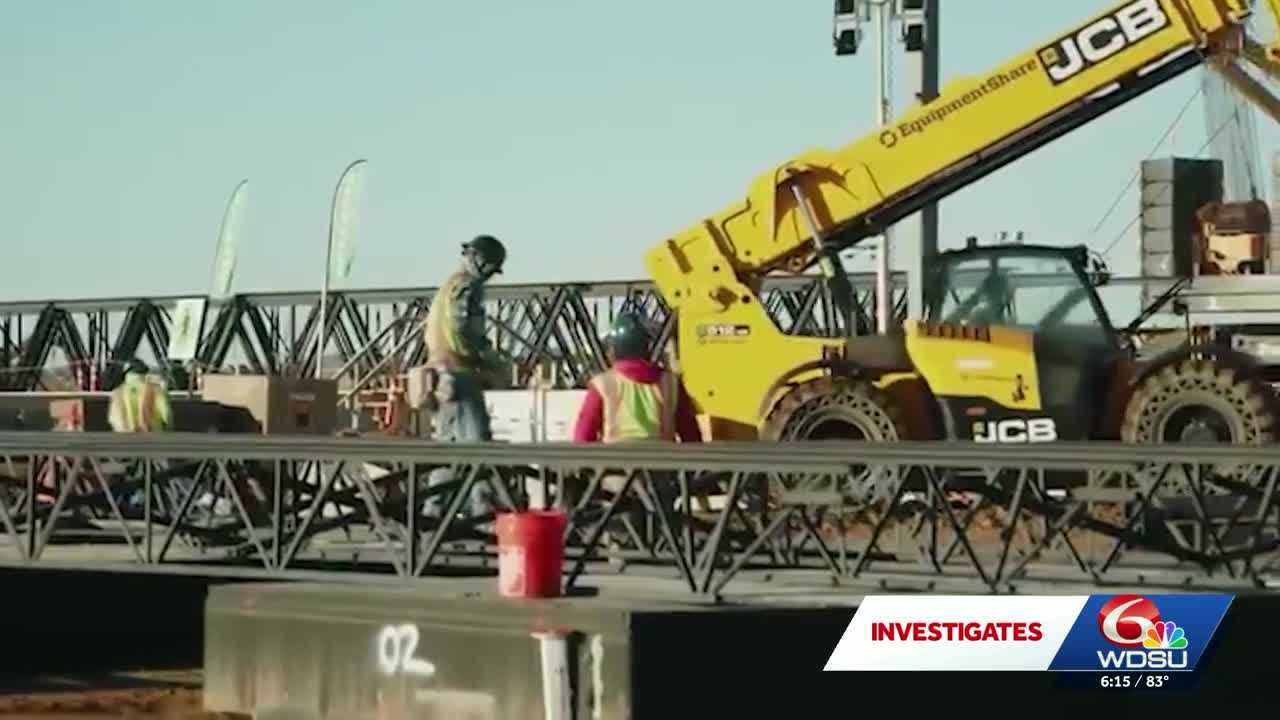
Putting on his welder’s mask and going to work — Gov. Jeff Landry is quick to celebrate a $300 million tugboat project in Plaquemines Parish.
The boats support the growing liquefied natural gas business booming across the state.
Louisiana’s economic development czar is claiming victory.
“Frankly, the systems we have out in place — and I think any of the business leaders we have here today will tell you — it’s why we’re winning,” said Susan Bourgeois, the Secretary of Louisiana Economic Development.
But some question the cost.
“Not every economic deal is good economic development — some harm communities,” said Davante Lewis, a Public Service Commissioner.
Lewis says LED and the Landry administration are lacking in transparency when it comes to big-ticket projects across the state.
“We’re seeing a whole list of public conversation turning into private conversations,” Lewis said.
In question is the Landry administration’s use of non-disclosure agreements limiting people from commenting on things discussed in private meetings.
“An NDA is a fundamental part to any economic development project we work on. They’re driven primarily by the companies,” Bourgeois said.
But it’s not just private businesses signing them to keep trade secrets and financial elements quiet.
An LED spokesperson confirms to WDSU Investigates that more than 50 elected leaders in Louisiana have also signed them.
The list includes well-known senators, state representatives, parish presidents and even sheriffs.
Bourgeois admits that it’s unique.
“When we negotiate these deals, we want our legislative leaders to understand what could be coming to their region, and give us background and nuances, so we have invited legislators who are willing to sign these NDAs so they can participate in these economic development projects for their region,” Bourgeois said.
“So I generally oppose them … think this a problematic trend that we are seeing in this state of keeping and shielding information from the public,” Lewis said.
Lewis has not signed an NDA , but confirms that the executive secretary of the Public Service Commission did.
That five-member panel of elected leaders regulates public utilities like power, water, and gas providers across the state.
“In no way did he believe he was signing it on behalf of all of us,” Lewis said.
Lewis said that is good because the PSC will play a key role in regulating large data plants springing up across the state.
The Meta data center in Monroe is the size of a small city, and the Amazon data center near Shreveport is also massive, raising concerns over the use of power, water and gas.
LED confirms that plenty of lawmakers from north Louisiana signed NDAs to be involved in the talks.
“It’s different when it’s the government because the government has certain transparency obligations to the public and NDAs are a direct violation of those transparency obligations,” said William Most, a New Orleans-based lawyer who specializes in public accountability issues.
He says NDAs should not be used when taxpayer money, public property and government funding are in play.
“What this is really about is hiding these projects from the little guy until after it’s already done, because what I think the government wants to do is get these projects through without the public knowing about it, and it’s too late to raise any concerns,” Most said.
At the event in Plaquemines Parish, where the governor announced a multimillion-dollar project, he owned the decision to use NDAs in Louisiana.
“I think when these projects are going on, corporations don’t like to talk about their plans because it exposes it to their competition and it has a chilling effect on our ability to do things effectively, and guess what, it’s working,” Landry said.
“Where people’s voices matter most is before the deal is signed. Is this a deal that people will respond to? Is this the type of economic development that people want to see?” Lewis said.
Louisiana Economic Development hears the criticism, but doesn’t appear to be tweaking its playbook.
“I think an important component that is not talked about enough, once a deal is announced, every detail of it becomes public. None of this remains proprietary or shrouded in secrecy after the negotiations are done,” Bourgeois said.
Since he took office in January 2024, Landry says his administration has brought in over $60 billion in economic investment.
As for the massive data centers mentioned, our Data Team did a deep dive.
Here’s some more context on those:
Eighty-seven percent of data centers are built in rural areas.
The Meta and Amazon centers are following that trend. Louisiana currently has 21 data centers, which puts us 33rd in the country.
The most are in Virginia, where there are over 600, and Texas is second with over 500.
READ MORE:WDSU Investigates: Louisiana lawmakers sign non-disclosure agreements for economic development