Potholes and New Orleans go together like red beans and rice.
Back in March, Mayor Helena Moreno announced that her administration would work to fill 1,500 potholes each week through their “Smooth Streets” initiative.
As of this week, the city says it has only repaired fewer than 1,000 over the last two weeks.
In that same time, an anonymous artist has been fixing streets one pothole at a time, and the identity of the artist has become quite the mystery.
“When I got here to open the store, there was somebody out front,” said Alli Mathas, manager at Hazelnut on Magazine Street.
“They had cones. They were wearing like a traffic vest kind of thing. They had cement. There’s a whole setup out of a little, tiny car,” she said.
According to Mathas, it looked like official work was being conducted.
“At first, I thought maybe it was somebody from the city, but then I realized pretty quickly that it wasn’t.”
When asked why they work anonymously, the answer was given through an interpreter to keep their identity under wraps, and that mystery worker is better known as the Buffalo Pothole Bandit.
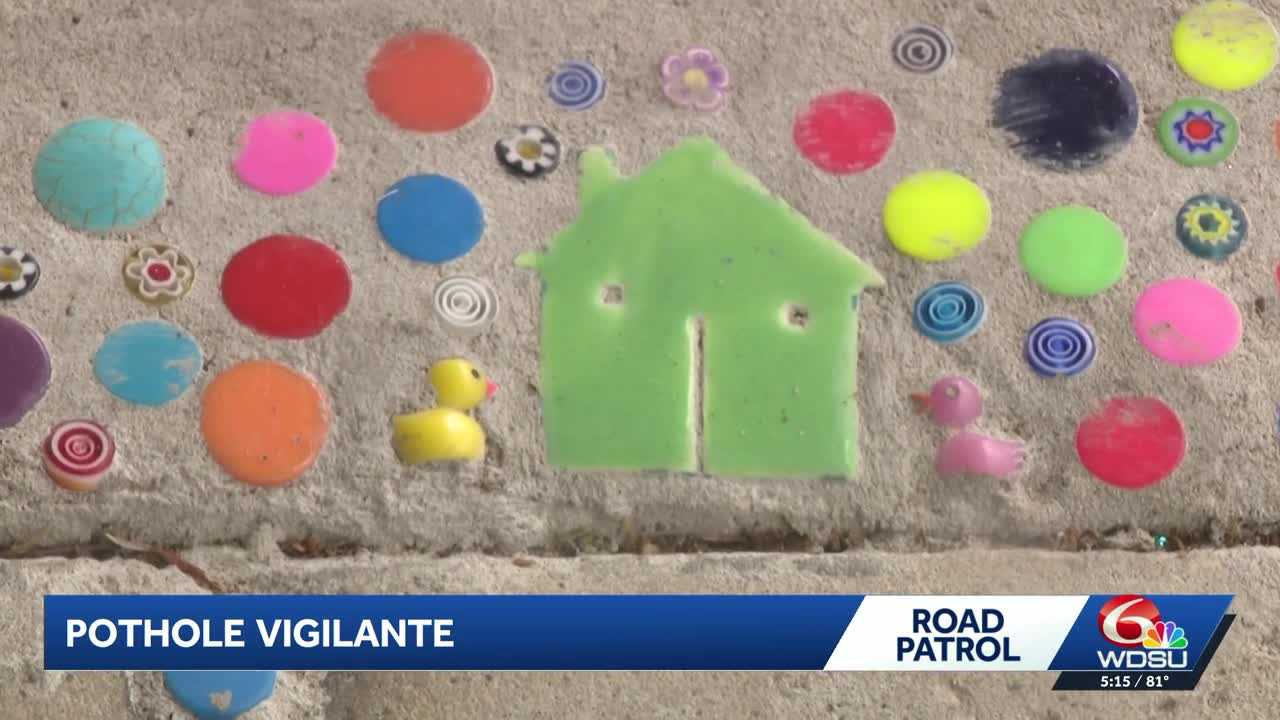
“The goal is to add art to the world utilizing potholes as the medium,” said the Pothole Bandit.
Whether it’s cracks in the sidewalk or potholes in the road, the bandit has left behind hundreds of mosaic street art installations in New York, Pennsylvania, Chattanooga and now New Orleans.
“Mosaics are the most practical, I guess, idiom to use in a pothole, frankly, right,” they said.
“Paint is not going to really hold up for too long. People are driving and walking over it, et cetera. The mosaics fill it up and have some nice additions to it,” they explained.
According to the Pothole Bandit, the artwork is functional, practical through its use of reusable items and often inspired by neighborhood fixtures.
“It is wild the amount of people who just appreciate the fact that something is being done for these streets, when sometimes you have potholes that last years,” said Tyler Van Dyke of NOLA Art Walk.
An example of this would be a piece titled “The White Whale,” commenting on the lack of enforcement for a truck reportedly left sitting for years and the holes forming around it.
“It’s a very laissez-faire city, right, so at least for this city, permitting, you know, ideally, you would love to see the potholes filled, but sometimes, you have to fill it yourself,” explained the Pothole Bandit.
Working solo on these cheeky acts of rebellion, the Bandit has filled more than 30 potholes across New Orleans in just two weeks.
“It’s such a fun little expression of joy right now. I think it’s very New Orleans,” said Mathas.
“I don’t know, it just, it makes me smile, and I’m really happy that it’s on Magazine Street,” she said.
The Pothole Bandit says there have been nearly 100 requests for pothole art installations in the city, but you will have to catch them before they are gone.
According to the city of New Orleans code enforcement, even pothole art could be considered graffiti, which is criminal.
In a statement, it said:
“In practice, it is treated as unauthorized markings placed on property without the consent of the owner. Whether it appears on public or private property, such activity is generally classified as criminal property damage and/or vandalism under existing law.”
If you would like to learn more about the Buffalo Pothole Bandit, you can visit their website: BuffaloPotholeBandit.com
READ MORE:Road Patrol: Buffalo Pothole Bandit makes mysterious stops on New Orleans streets