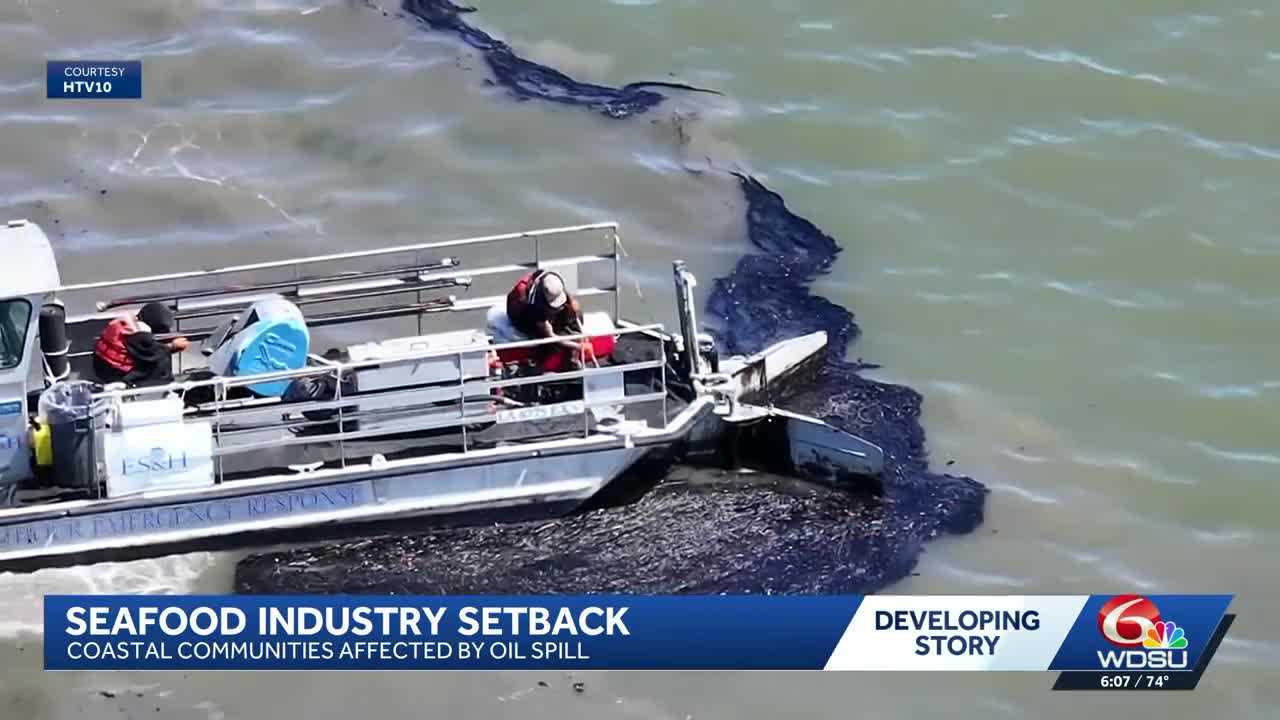
Concerns are growing along Louisiana’s coast after an offshore oil spill forced widespread oyster closures in Terrebonne Bay, impacting thousands of acres of productive waters and raising new questions about what comes next for the state’s seafood industry.
State health officials have closed more than 160 square miles of oyster harvesting areas, affecting more than 2,400 private leases and public seed grounds after oil from the spill reached coastal marshes and barrier islands. The closures span multiple harvest areas in Terrebonne Bay, where officials say the move is precautionary to protect public health.
The spill happened on Feb. 26, about 18 miles offshore at the Louisiana Offshore Oil Port, known as LOOP, when a cargo transfer hose failed during operations.
“We had a failure in one of those hoses,” said Chris Levat, incident commander for LOOP during an interview with HoumaTV. “That was the cause.”
Levat also apologized to the community, saying the company never wants an incident like this to happen and is committed to addressing its impact.
Officials say about 750 barrels of oil, or more than 30,000 gallons, were released into the Gulf. LOOP says operations were shut down immediately, and a unified command was established with federal and state agencies to respond.
“We immediately shut down operations and began investigating what we had on the water,” Levat said.
The response is now being coordinated by the U.S. Coast Guard, state agencies and LOOP, with hundreds of responders, vessels, aircraft and drones working to track and remove the oil. Officials say no chemical dispersants have been used in the cleanup and none were requested.
“Every oil spill is unique,” said Cmdr. Michelle Ferguson with the Coast Guard. “You look at the characteristics of that oil and apply the appropriate cleanup methods.”
While officials say much of the oil has been recovered offshore, some has made its way into marshes and barrier islands, which are more difficult to clean and more environmentally sensitive.
Even though officials stress the spill is significantly smaller than the Deepwater Horizon disaster, they acknowledge its impact is being felt locally, especially in Terrebonne Bay.
In Houma, that impact is already being felt across the seafood industry, where uncertainty is beginning to ripple through those who depend on the water.
At Jennie V’s Seafood, owner Jenny Ancar says the biggest challenge right now is not just what is known, but what is not.
“There’s a lot of unknown right now,” Ancar said. “Our planting season is right now in the spring, and we’re concerned about that with this going on, because we’re hoping that we don’t have to cancel that.”
Spring is a critical time for oyster farmers, when new beds are planted, and future harvests are set. Ancar says this spill is now threatening that cycle and the people behind it.
“It affects our fishermen,” Ancar said. “They’re scared. They don’t know what’s going to happen. It affects everything that we’ve done, and we don’t know the long-term effects of what it will do.”
For her, the concern is also personal. Her husband is on the water right now, monitoring conditions firsthand.
“My husband is on the water,” Ancar said. “He is monitoring this, like, as we speak this whole time, and things are not looking very good. He’s very active in the field, and he’s not liking what he’s seeing.”
Back at the business, she says customers are already asking questions about where their seafood is coming from and whether it is safe.
“They’re asking,” Ancar said. “And we just tell them where we are fishing and that it is safe where we are at. They feel confident about that. They trust us.”
Even with some areas still open, Ancar says the uncertainty extends beyond today’s supply and into the long-term health of the industry and environment.
“There’s a lot of unknown right now,” Ancar said. “And it’s the unknown that’s more than anything.”
Still, she says the community is coming together as it waits for answers.
“It affects our fishermen,” Ancar said. “We love our fishing community, the oil workers community. Nobody wanted this to happen. So we’re just taking it day by day until we find out more.”
State officials say oyster testing cannot begin until the water is clear of oil, and there is currently no timeline for when the closed areas could reopen.
In the meantime, cleanup efforts continue, and coastal communities say they are watching closely and hoping the long-term impact is limited.
READ MORE:Oil spill closes oyster waters in Terrebonne Bay as seafood industry faces uncertainty