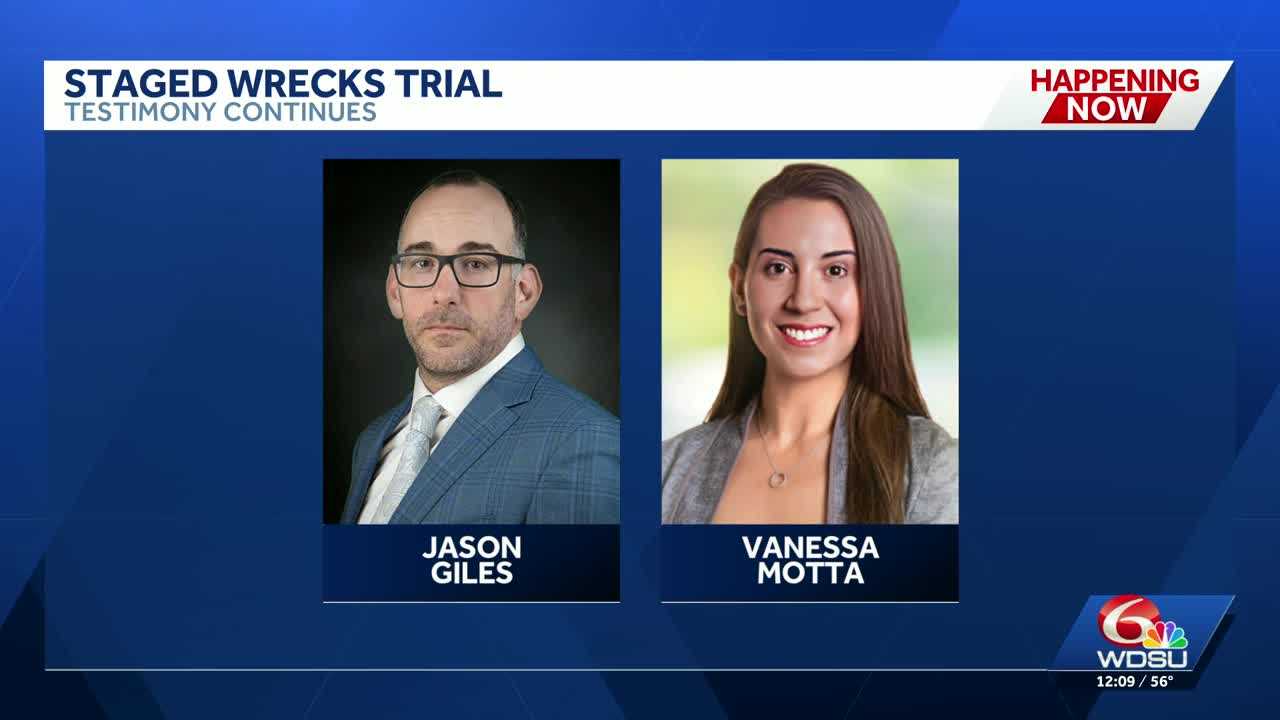
The fate of two well-known New Orleans lawyers has been decided after three weeks of testimony in a wide-ranging staged wrecks and insurance fraud trial.
The verdict has been reached after five and a half hours of deliberations.
The courtroom is full as the jury prepares to enter and give the verdict.
Stay tuned for updates.
Vanessa Motta and Jason Giles stood trial and are both accused of staging car crashes to fraudulently collect insurance money.
Motta, a former stuntwoman turned plaintiff’s lawyer, and Giles, a principal at the King Firm, are charged with wire fraud, mail fraud, obstruction of justice and witness tampering.
Federal Judge Wendy Vitter ordered a witness to return to the stand Thursday after prosecutors revealed handwritten notes and photographs that they had not given to the defense. The court said the oversight broke disclosure rules and limited the defendant’s right to question the witness.
The documents included a one-page handwritten statement and seven pages of photographs of African American men. The FBI had the material, but the agency did not provide it to defense attorneys until Thursday morning. The judge said she believed the failure to turn over the items was a mistake and not an attempt to hide evidence, but she reminded prosecutors that they are responsible for sharing information on time.
Vitter said the new material had some value for challenging the witness’s credibility. She ruled that the defense did not have a fair chance to question the witness during her first appearance. The judge approved the defense request to recall the witness and ordered prosecutors to bring her back right away.
If prosecutors didn’t return the witness quickly, the judge warned she may strike the witness’s entire testimony from the record. Prosecutors said they had already rested their case before the jury, but the judge said the defense still has the right to a complete cross-examination.
The judge showed frustration about the delay and said it was the kind of disruption she hoped to avoid.
The witness showed up in the courtroom around 10:30 a.m. to complete testimony.
The federal government and defense then rested their cases.
Closing arguments:
The federal government delivered sweeping closing arguments Thursday afternoon after testimony concluded, arguing the entire scheme was ultimately about greed and was a coordinated effort between attorneys, runners, and slammers.
“This is a case about greed,” said Ryan McLaren, prosecutor for the federal government. “You’ve seen evidence of the defendants’ greed over and over again.”
McLaren stressed that Motta and Giles knowingly participated in the scheme for years, staging accidents and recruiting people to participate and file fraudulent insurance claims.
“The slammers were the beating heart of this conspiracy,” said McLaren.
McLaren also emphasized that the scheme heavily depended on the attorneys, Motta and Giles, who were often lined up and ready before crashes even happened.
McLaren also outlined phone records and text messages, including coded language to discuss the scheme with the slammers.
Jurors were shown evidence of calls and texts between Giles and Labeaud around the time of the crashes. Prosecutors argued the volume and timing of those messages showed Giles’ knowledge of the scheme.
“What do you think they were talking about — the Saints? The weather?” McLaren asked the jurors.
McLaren also outlined Giles and Labeaud’s close relationship and said that Labeaud had no reason to hide the meaning of the messages.
McLaren told the jury that the financial records outlined in the trial showed fraud through checks and the thousands of dollars given to people who were involved in the scheme.
McLaren also spoke heavily about Motta’s alleged involvement, specifically outlining phone and location data showing Cornelius Garrison, a key slammer in the case, traveling to her office after crashes.
He also reiterated that Motta was accused of trying to pay Garrison to move out of the country to prevent his cooperation with the federal government’s investigation.
McLaren said Motta and her fiancé, Sean Alfortish, are “partners in romance and partners in crime.”
In closing, McLaren urged the jurors not to view Giles and Motta as unaware of the wide-ranging scheme.
“You do not need to presume that they are stupid people,” said McLaren. “They are not. Sometimes, people are just guilty.”
Rick Simmons, the attorney representing the King Firm, began his closing arguments by recognizing the burden the jury has to weigh each charge against the defendants.
Simmons said he agreed with the prosecution’s stance about the staged wrecks scheme, saying the case was about lying. But he stressed that the lying came from slammers.
Simmons said the slammers lied to attorneys, police, in their depositions, and to the FBI.
He claimed that the government did not prove the King Firm was part of the conspiracy.
“They can’t find one check between the King Firm and Mr. Garrison or Mr. Harris,” said Simmons. “They can’t find any phone records.”
He also stressed that the first crash in the scheme dated back to 2011, when the King Firm didn’t exist.
Simmons ended his closing argument telling jurors that when the King Firm heard there were concerns of fraud in cases, the firm withdrew and did its due diligence.
Sean Toomey, Vanessa Motta’s attorney, focused his closing argument on whether or not the federal government proved she had knowledge of the scheme.
He stressed that Motta did not know that the referrals she was getting from her fiancé, Sean Alfortish, were from staged accidents.
“She was a pawn of Sean Alfortish, and foolishly held onto what she thought were green flags,” said Toomey.
Toomey painted the picture of Alfortish being the true orchestrator in the scheme, saying the government focused too much on assumptions tied to her relationship with Alfortish.
“They jumped to the conclusion that because she was his girlfriend and a lawyer that she had to be involved,” Toomey said. “They were never open to the idea that she was misled.”
Toomey also outlined inconsistencies during testimony, specifically saying some witnesses evaded questioning on cross-examination or answered questions in ways that felt scripted.
He also said most of the government’s witnesses testified that slammers, Cornelius Garrison and Ryan Harris, staged the crashes, not Motta.
“They all said the same thing: it was Garrison, it was Harris who set it up,” said Toomey.
Toomey said Motta made bad decisions, but none with criminal intent.
“She made an incorrect judgment,” Toomey said. “That may make her inexperienced — even a bad lawyer — but it does not make her a criminal.”
Toomey told the jury that the government’s case against Motta was built on suspicion and not proof.
“Vanessa is not guilty,” said Toomey.
Jason Giles’ attorney, Lynda Van Davis, urged jurors to acquit him because the government did not prove beyond a reasonable doubt that he staged wrecks.
Davis pointed out that several people testified in the case to their involvement, but said none of those people credibly implicated Giles.
“The people that did this have been punished, and they should have been,” Davis said. “But that doesn’t mean my client is guilty.”
She pointed to testimony from Carl Morgan, who admitted his own involvement in a staged accident but told jurors he did not inform Giles that the case was fraudulent.
Davis argued that Morgan, despite having a plea agreement, did not attempt to reduce his sentence by falsely implicating Giles.
She also challenged the credibility of slammer Ryan Harris.
While Harris testified that members of his family were involved in staged accidents, Davis pointed out that he never knew if Giles had knowledge of the fraudulent cases. She emphasized that Harris’ only connection to Giles’ law firm was being in the parking lot.
Davis insisted there was a lack of concrete evidence in the case.
“Where is the proof?” Davis asked. “No phone records, no payments, no location data.”
Davis told jurors there was a distinction between Giles’ firm and Vanessa Motta’s firm, arguing that any fraudulent activity happened there.
“The things that happened at the Motta firm did not happen at the King firm,” Davis said.
Davis also questioned the credibility of a key prosecution witness, Damian Labeaud.
She called him a liar and questioned claims that he made large sums of cash through staged accidents. Davis argued there wasn’t enough financial evidence to support those claims.
Throughout her argument, Davis maintained that Giles was simply doing his job as a trial lawyer, relying on his clients’ statements.
“If someone comes in and tells you they’ve been injured, a lawyer has to evaluate that case,” Davis said. “That does not mean they are part of a fraudulent scheme.”
Davis ended her testimony stressing to jurors that the government did not prove Giles committed mail fraud, obstruction of justice, or witness tampering.
“The government missed the mark by a long shot,” Davis said. “Don’t send my client to jail because other people came into his office and lied.”
Judge Wendy Vitter gave the jury their instructions, and jurors are expected to begin deliberations Friday morning.
Toomey and Van Davis were spotted outside of court after Vitter dismissed for the day, and both gave short statements reiterating that the case is now up to a jury.
Trial testimony:
The trial centered on allegations that several attorneys were involved in a large-scale staged car crash scheme designed to defraud insurance companies.
Rick Simmons, representing The King Firm, argued that the firm’s cases came through legitimate advertising and reputation, and that the people accused of staging crashes operated on their own.
Lynda Van Davis, representing Jason Giles, stressed there was no evidence linking Giles to a conspiracy, specifically saying the indictment did not include lawyers as participants in the alleged scheme and urged jurors to “follow the money.”
Sean Toomey, representing Vanessa Motta, portrayed her as an inexperienced lawyer misled by her fiancé, Sean Alfortish. He argued that Motta believed referrals on the car wreck cases were legitimate and was unaware that Alfortish allegedly paid people to stage them.
Toomey characterized her actions as naïve rather than criminal.
Prosecutors, however, presented a starkly different narrative, describing the case as a greed-driven fraud operation.
Federal prosecutor Brian Klebba alleged that attorneys Motta and Giles knowingly participated in staging crashes involving 18-wheelers to secure large insurance settlements, paying runners and slammers, and generating millions in fraudulent payouts.
A major witness for the federal government, former attorney Danny Keating, testified that he actively participated in the scheme between 2017 and 2020.
He admitted to helping stage over 100 crashes, filing fraudulent lawsuits, and handling cash payments to participants.
Keating described the coded language used by the group and detailed how money was distributed, sometimes wrapped in newspaper.
Another key witness for the government, Damiean Labeaud, testified that he worked as a “runner” for years and claimed Giles paid him thousands weekly to organize staged crashes.
He described recruiting participants, coordinating accidents, and directing clients to specific doctors.
Defense attorneys challenged his credibility, suggesting he was shifting blame to reduce his own sentence in the case.
Ryan Harris, a “slammer,” testified that he staged more than 80 crashes tied primarily to Motta and Alfortish.
He claimed Motta was directly involved, instructing participants, advising on making crashes appear convincing, and even suggesting ways to increase damage for insurance payouts.
Defense attorneys questioned inconsistencies in his statements and whether Motta knew about the scheme.
Finally, FBI Special Agent Matthew Smith testified about his investigation, which began in 2019 after suspicious crash patterns were reported by law firms representing 18-wheeler companies.
He played recorded calls in court and outlined statements from key figures, including Cornelius Garrison, a key federal witness who was murdered before trial.
While prosecutors argued the evidence showed a coordinated scheme, Toomey, Simmons, and Van Davis continued to point to what they called inconsistencies in witness statements as well as gaps in evidence linking Motta and Giles to the scheme.
About the scheme
The scheme has drawn significant attention from the legal community due to the state’s high auto insurance rates.
The federal investigation was launched months after WDSU Investigates broke the story in October 2018, following reports from lawyers for trucking companies about the repeated involvement of the same individuals and law firms in multiple crashes, notably the Motta Firm and the King Law Firm.
The investigation led to changes in state laws to better protect truck drivers, who are required to carry $1 million in liability insurance.
More than 50 individuals have pleaded guilty to participating in the scheme after admitting to driving into tractor-trailers to stage wrecks.
In 2020, U.S. Attorney Peter Strasser described the scheme as “outrageous.”
Attorney Danny Keating, who pleaded guilty and is awaiting sentencing, reportedly collected over $1 million by handling 77 fraudulent cases.
Keating is expected to testify at the trial, along with other lawyers who have received transactional immunity for their cooperation.
Motta and Giles have pleaded not guilty, with Motta represented by former federal prosecutor Toomey and Giles by Van Davis.
The trial, presided over by Judge Wendy Vitter, a Donald Trump appointee, is expected to last four to five weeks.
A significant aspect of the case involves the homicide of a federal witness, Garrison, who was killed in 2020 after agreeing to cooperate with the investigation.
Two men, Alfortish, Motta’s fiancé, and Parker, are charged in the killing, with their trial set for August.
Motta and Giles are not charged in connection with the killing, and the judge has separated those charges to be tried later.
The jury will focus solely on whether the wrecks were staged and if Motta and Giles played key roles in the scheme.
READ MORE:After nearly three weeks of testimony, jury has reached a verdict in staged wrecks case