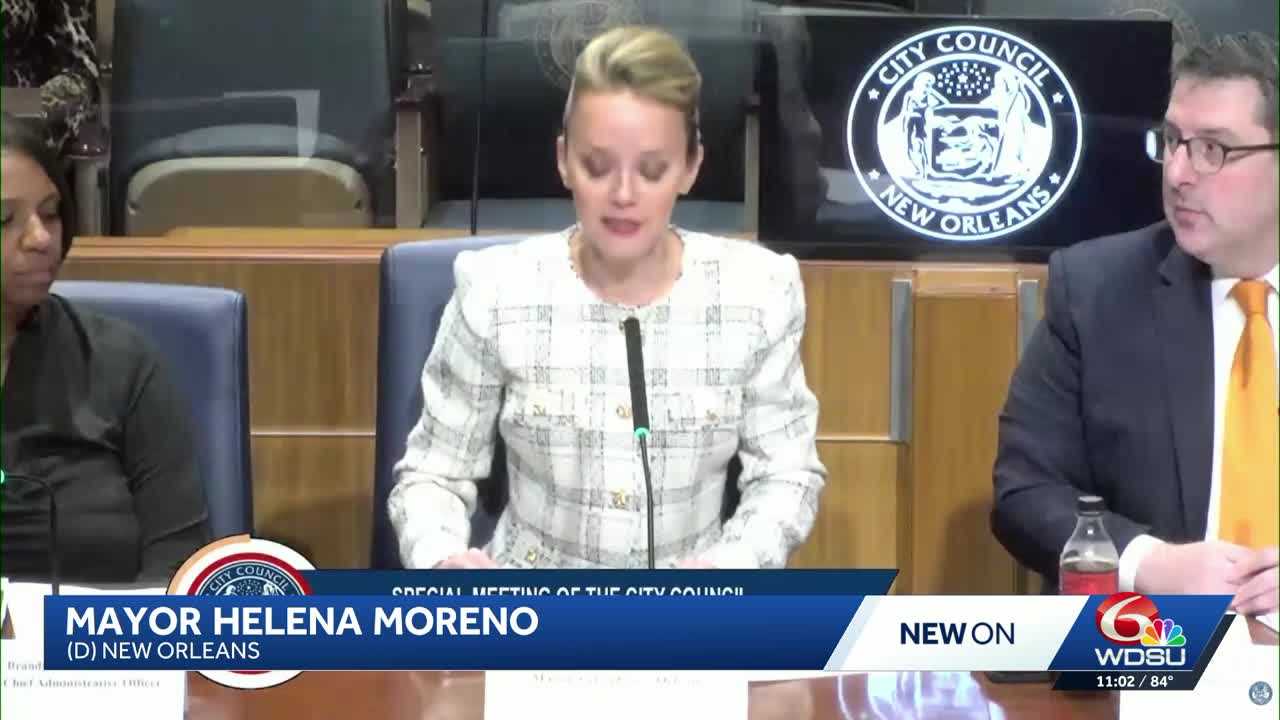
New Orleans City Council members met Tuesday at City Hall to discuss next year’s budget, which faces a $100 million deficit, and potential property tax adjustments to address the shortfall.
The administration is proposing an ordinance to levy millage rates for 2027. It includes rolling forward several millages. The last full roll forward occurred in 2015.
The goal of the proposed adjustments is to use property tax rates to fill the financial gap, but this could mean higher taxes for New Orleans property owners in 2027.
A millage is the property tax rate used to calculate how much you owe based on your home’s value.
The city’s rate is broken down into different departments and services. The city is looking at increasing millages for the general fund and direct city services like police protection, fire protection, Parks and Parkways and NORD. There are also proposed increases for libraries, early childhood education, Audubon Commission and City Park improvements.
Not necessarily all of these millages have to be rolled forward, but if they were, it would generate $42 million total in revenue, according to CAO Joe Giarrusso.
Giarrusso gave an example of how this would impact property taxes. If you own a $250,000 home, and all millages were rolled forward, you would pay $141.13 more annually.
As things stand right now, the city needs to make $77 million in cuts to balance the 2027 budget. If they raise this money through the millages, they’ll be able to determine which cuts they can take off the table.
Councilmember Freddie King raised concerns about misinformation surrounding the budget among the public. He said it will be hard to get residents to support any type of tax increase, especially if they are not informed on the proposal.
Councilmember Lesli Harris said more information surrounding what cuts could be eliminated with these millages would be helpful to communicate to constiuents.
Last week, New Orleans Mayor Helena Moreno said that additional recurring revenue is needed to help reduce the deficit.
Tuesday’s meeting was the first of 10 scheduled budget discussions and is open to the public.
View the full 2027 budget proposal here.
What is being protected:
The most notable change to the 2027 budget is the lack of furloughs for city employees. Cuts would not be made to the New Orleans Recreation Department or the Council on Aging, and the city would make an effort to protect the New Orleans Police Department, the New Orleans Fire Department, and EMS personnel from major cuts.
The budget also seeks to protect essential city services like street repairs, sidewalk maintenance, and sanitation.
Addressing a shortfall:
Moreno’s proposed budget is $763 million, which is built around $748 million in recurring revenue.
Despite this, the city is still facing a roughly $100 million deficit going into 2027.
According to the proposed budget, the $100 million gap will be addressed with $77.7 million in direct cuts and $21.55 million in one-time or special-purpose funding to avoid any further reductions across the city.
Major cuts:
Some city departments were hit hard by budget cuts in the proposal.
The New Orleans Health Department is facing a 51% budget cut, Public Works a 35% cut, and the New Orleans City Council’s budget would be cut by 29%.
The NOPD faces a 2% reduction, and the NOFD faces a 10% reduction in budget.
The budget also proposes tight reductions, including 152 full-time equivalent positions being reduced, a $1.75 million reduction to Mardi Gras post-parade cleanup services, a $5 million reduction in low-barrier shelter operations, and a $2.5 million cut to the Axon contract used for body cameras, in-car cameras, and Tasers.
Generating revenue:
This proposal includes rolling forward eligible millages, which is estimated to bring in $20 million in revenue. This move would raise property taxes for New Orleans residents.
The city is also considering raising short-term rental fees and increasing permit fees tied to inflation. Nonprofit parcel fees could also be enacted, according to the proposed budget.
State of the financial crisis:
The city’s presentation has an entire slide dedicated to how the budget crisis came to be.
The slide, titled “Inherited Chaotic, Misleading Budget for 2026,” references the former administration’s management of money.
The slide alleges years of delayed financial management, no money to make payroll, no savings except for the city’s rainy day fund, and a budget that far exceeded the city’s revenues.
Moreno’s letter to council members stresses that the city is in a much better financial position than last year and acknowledges that the proposed budget is difficult.
What comes next:
The budget proposal would need to be adopted by the full council.
The 2027 budget must be adopted by the first week of December.
READ MORE:Everything you need to know as the New Orleans budget hearings begin