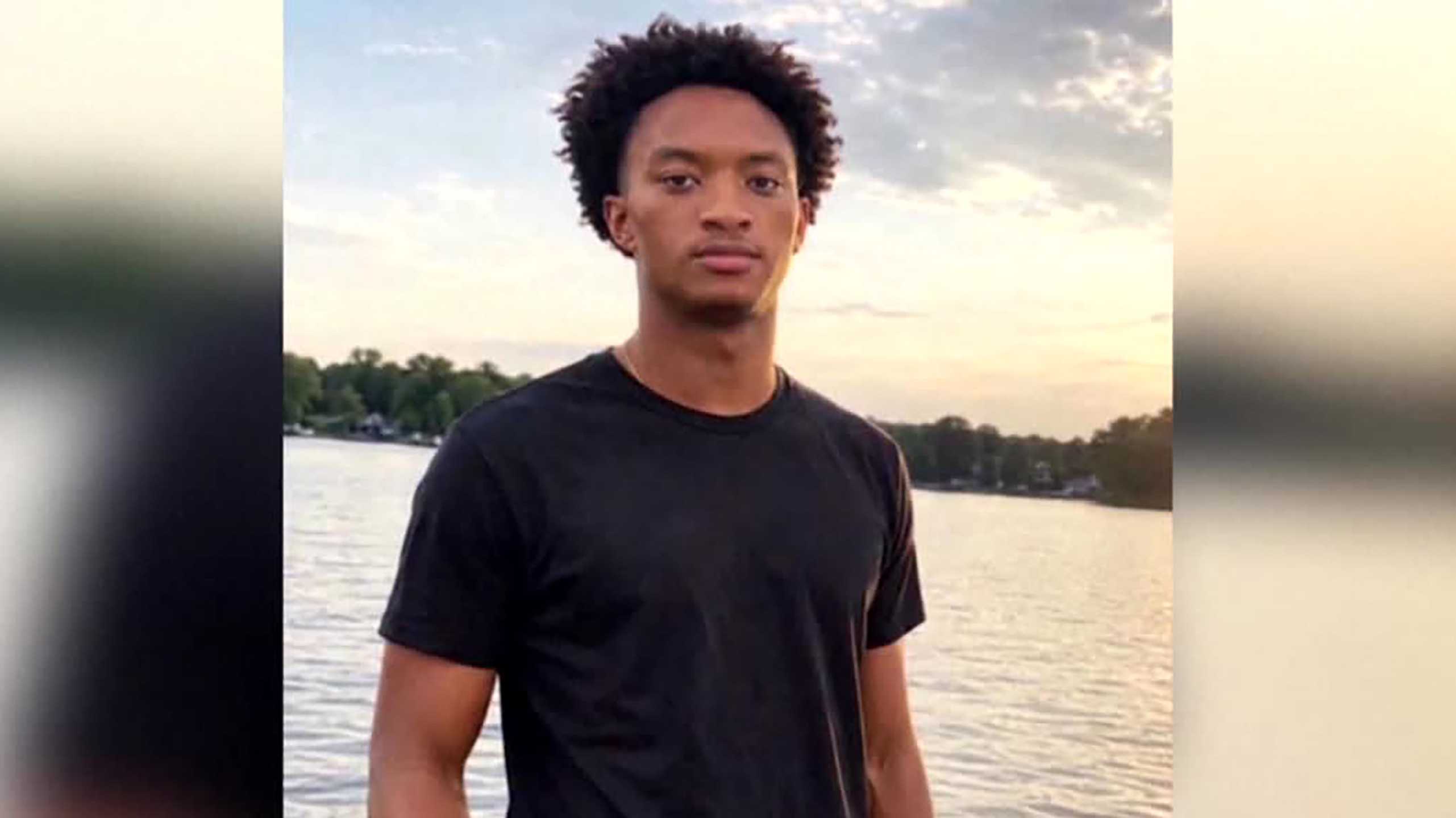
Snapchat conversations, a state autopsy report and context from a forensic analyst regarding the examination of a Mississippi teen’s phone were shared in a news conference Thursday morning as the family continues to seek answers surrounding their son’s death.
Attorney Ben Crump was joined by Andrew Garrett, CEO of Garrett Discovery, to release the findings from an extraction of Nolan Wells’ phone.
Wells died on Horn Island on July 4.
Crump and his team called for further investigation into his death, arguing that messages from his friends, forensic phone data and injuries documented during his autopsy raise questions about the conclusion made by a grand jury that he accidentally drowned.
The news conference comes after a grand jury in Jackson County, Mississippi, declined to charge anyone criminally in Wells’ death.
VIDEO: Crump reads some Snapchat messages from Nolan Wells’ phone
Crump read excerpts from Snapchat messages exchanged among Wells’ friends but did not identify the people who wrote them. According to Crump, the messages described two “sketchy looking guys” in nearby boats as “felons.”
In another message, a friend said their father had escorted a woman to her boat and warned, “You don’t want to be left alone with those guys, especially if you were drunk.”
Other messages shared the day after Wells’ death expressed concern about encountering “racist people” on Horn Island.
Crump said the conversations indicate that some of Wells’ friends also questioned whether he drowned.
Attorney Liza Park also disputed District Attorney Angel Myers McIlrath’s account of how Wells’ cellphone was handled after his death.
According to Park, Wells’ parents and prosecutors initially agreed to conduct a joint forensic examination of the phone following a July 15 meeting. However, Park claims the time and location were never finalized and communication between McIlrath’s office and Wells’ family became strained.
VIDEO: Park explains communication between the Wells family, Mississippi officials
McIlrath’s office later proposed conducting the examination at a community college facility controlled by law enforcement, according to Park. Park said the family’s forensic specialist would not have been allowed inside, which was an arrangement they said differed from the family’s wishes and their original agreement.
After receiving requests from the district attorney to surrender the phone, Wells’ parents arranged for their expert from Garrett Discovery to create a forensic copy of Wells’ phone at their home before turning over the device. The family said they wanted to preserve the phone’s contents and protect against any loss or alteration of evidence, according to Crump.
The extraction took nearly 24 hours. Park said prosecutors were advised of the delay and agreed to it. She maintained that Wells’ parents cooperated and ultimately gave the district attorney the complete extraction reports.
Park said they do not know how the phone evidence was presented to the grand jury.
Analyst video details phone activity
Andrew Garrett of Garrett Discovery, the digital-forensics company hired by Wells’ family, said Wells rarely communicated through text messages.
Garrett said about 90% of Wells’ communications were through Snapchat and Instagram, including group conversations involving numerous people.
Garrett said his team used two forensic tools to examine the device, but the version of Snapchat installed on Wells’ phone was too new to be processed by the software. His team then spent about a week manually decoding and extracting the Snapchat information, according to Garrett.
Garrett said his investigation of the phone showed Wells used Face ID, communicated with others and opened several phone applications on the day he died. Investigators later relied on GPS and other device data to trace the phone’s movements after Wells stopped using it.
Garrett said his analysis identified activity involving the phone both before and after Wells’ death. He also confirmed that some material had been deleted but declined to speculate about who deleted it or why.
VIDEO: Timeline of Nolan Wells’ phone activity the day he died.
Messages continued syncing to the phone after Wells’ death because other participants remained active in group conversations, according to Garrett.
Garrett presented a video tracing the phone’s movements. Houses, names and street information were not shown in an effort to protect privacy.
The timeline showed Wells visiting a McDonald’s at 8:24 a.m. the day of his death, and arriving at another person’s home at 8:37 a.m. Snapchat was used on Wells’ phone during portions of that trip, according to Garrett.
According to Garrett, Wells boarded a boat at approximately 9:31 a.m. and arrived at Horn Island around 11:18 a.m. Snapchat messages were sent between the time he boarded the boat and the group’s arrival at the island.
Garrett identified 2:18 p.m. as the last time Wells personally locked the phone. Sea Tow was called at approximately 4:35 p.m. because of a problem with one of his friend’s boats’ bilges. The boat later traveled to a dock at about 6:30 p.m. and then to a boat ramp around 7 p.m., clearing the ramp at 7:25 p.m.
At 8:51 p.m., the phone traveled to a home, according to Garrett. Wells’ parents retrieved it at approximately 3 a.m.
Garrett said his reports and the underlying phone data were given to the district attorney.
He said the state’s forensic examiners use the same principal tools as his company. Garrett also penned a letter to Crump’s legal team disputing McIlrath’s version of the events regarding the extraction of Wells’ phone.
State medical examiner’s report revealed:
Crump shared that Wells’ family received the state autopsy report from the Mississippi medical examiner Wednesday night.
Crump said that attorney Ahmad Smith had to request the report for the family after he reminded McIlrath that her office had not provided a copy.
Crump then read aloud a letter from McIlrath stating that the family would have to make an online request.
Smith informed McIlrath in a response letter that the family submitted an online request for the report Sept. 8 but had not received it two weeks later. McIlrath said the request did not include proof that the person seeking the report was Wells’ next of kin. Crump said McIlrath agreed to provide a copy to the family via email.
Crump thanked McIlrath for providing the report and said the family decided to release it publicly.
Crump read parts of the report out loud and described it as a three-page report.
According to Crump, the state medical examiner also documented two red-purple contusions on the back of Wells’ scalp. Each measured about 2 inches. The medical examiner also included a diagram of the injuries, which Crump showed on a printed piece of paper.
Park said the report found no fractures involving Wells’s larynx, thyroid bone or spine. Park said the report also documented no fluid or debris in the airways, no water in the throat or stomach, and an empty stomach.
According to Park, the state medical examiner classified Wells’ death as undetermined. Crump and Park both questioned how that finding aligned with the grand jury’s determination that Wells’ death was an accidental drowning.
Dr. Roger Mitchell, who conducted an independent autopsy for the family, reportedly found no white blood cells associated with the injured areas. According to Park, that finding could indicate that the injuries and bleeding occurred close to or shortly after Wells’ time of death.
“Bruises are an injury,” Park said. “Internal bleeding is serious.”
Mitchell is expected to discuss and compare the state and independent autopsy findings at a separate news conference next week in Atlanta.
Crump’s legal team provided what it described as the state medical examiner’s report on Wells’ death. WDSU has reached out to McIlrath’s office to confirm the authenticity of the report. At the time of this publication, a response had not been received.
WDSU has not obtained an official copy of the medical examiner’s autopsy but has submitted a request through the Mississippi Department of Public Safety.
Nolan Wells’ family reacts to grand jury decision:
Crump, along with other attorneys working the case, was critical of the grand jury’s decision, specifically citing injuries to the back of Wells’ head.
Crump said the team believed the grand jury did not consider the circumstances involving how the injuries were caused when making the decision.
VIDEO: Ben Crump demands justice for Nolan Wells
He also stressed that the injuries were noted in both the independent autopsy and that the Mississippi medical examiner’s report identified the injuries to Wells’ head.
“It just does not add up. If it was your child, would they accept what that grand jury said?” Crump said. “If they wouldn’t accept it, Nolan’s parents don’t have to accept it.”
According to Crump, his team will not stop seeking information on what caused Wells’ death.
Wells’ mother, Christine Wonsley, also spoke, stating that she felt the grand jury could not determine her son’s death was an accidental drowning when his death certificate says his cause of death is undetermined.
VIDEO: Nolan Wells’ mother weeps while reacting to grand jury decision:
Wonsley said she felt like her son did not receive a fair or transparent investigation due to narratives that were circulating online regarding her son’s death.
VIDEO: Nolan Wells’ phone records will be released this week:
Grand jury decision:
Wells was found dead on Horn Island over the Fourth of July weekend.
According to the grand jury report, the grand jury engaged in a thorough and complete investigation into Wells’ death, including reviewing witness testimony, physical and digital evidence, GPS data, cellphone records, videos and investigative reports.
The report states that the grand jury recognizes the public assertion that Wells was the only Black individual on Horn Island on July 4, but it found that he was not the only Black person there that day and says that these false assertions have led to misidentification, speculation and rumors concerning Wells’ death.
In a video statement, the Jackson County district attorney also addressed those concerns, stating, “The narrative that three white boys and a Black boy went to an island and only the white friends returned spread like wildfire; this was false.”
The grand jury found that Wells traveled to Horn Island on July 4 with a group of friends on three different boats and chose to remain at Horn Island after the three boats departed the island.
No credible evidence was found to support allegations that any persons who rode to or from Horn Island on the three boats July 4 engaged in any criminal conduct related to Wells’ death, according to the grand jury.
The report also states that the grand jury acknowledges that there is no statute of limitations on homicide cases in the state of Mississippi and that if credible evidence comes to light in the future that suggests Wells’ death was nonaccidental, the matter should be presented to the grand jury for further consideration.
Preliminary autopsy results:
Preliminary autopsy results for a Mississippi teen who died on Horn Island over the July Fourth weekend were announced Wednesday morning.
Crump joined Wells’ family at a news conference at the 117th NAACP National Convention in Chicago.
Crump announced that Wells’ autopsy results were inconclusive, noting that discoloration was found on the back of his neck. The doctor who conducted the autopsy said the finding was significant because it was not possible to determine why there was red discoloration behind the brain.
The family is awaiting the autopsy results and toxicology reports done in Mississippi for the official cause of death.
Officials said the findings were limited primarily because of the condition of the body and other examination constraints.
The doctor said the examination was also hindered by marked decomposition, which limited what forensic experts were able to assess. In addition, interior neck structures were absent, meaning that area could not be fully evaluated during the second autopsy.
VIDEO: Explaining Nolan Wells’ autopsy results:
According to the report, that can be normal if the original medical examiner removed tissue for further examination of the neck.
Examiners also said they were unable to determine whether there was water in Wells’ airway because the airway could not be examined and neither could his stomach.
The autopsy also could not determine whether Wells was conscious or unconscious when he entered the water.
During the press conference, the family and their attorney said several important questions remain unresolved.
Those included the position of Wells’ body when he was found, whether there was water in his airways, whether there is evidence of injuries to his neck, what the intracranial imaging shows, the stomach contents, and the details of the toxicology report.
NFL Hall of Famer Terrell Owens is offering $25,000 to anyone with information about Wells’ death.
This brings the total reward to $125,000, which includes contributions from the Rev. Al Sharpton and Tyler Perry.
Wells’ funeral was held Monday morning.
No arrests or formal charges have been announced in connection with the case.
What was the cause of death?
Two concurrent autopsy investigations were conducted to determine Wells’ cause and manner of death.
The Mississippi state medical examiner’s office conducted the official autopsy investigation, Jackson County Coroner Bruce Lynd said.
There were no immediate, obvious signs of foul play or trauma on Wells’ body, Lynd said. But due to the uncertain circumstances, “we asked for an autopsy (at) the state medical examiner’s office so that they could do the full autopsy and be able to tell if there was any foul play or trauma,” he said.
VIDEO: Nolan Wells’ family calls for federal investigation into his death:
The state medical examiner’s office performed an autopsy July 7 and has been waiting for results from toxicology tests, Lynd said. It can take weeks to receive results from toxicology tests, which are standard in death investigations.
Separately, Wells’ parents sent their son’s body out of state for an independent autopsy, Crump said.
“We had his body flown from Mississippi to Washington, D.C., because his family wanted to make sure that they had a doctor who had no ties to Mississippi law enforcement to do an independent examination of their son’s body,” Crump said.
According to the independent autopsy report, Wells’ death was undetermined.
The doctor who conducted the independent autopsy said the finding was significant because it was not possible to determine why there was red discoloration behind the brain.
READ MORE:Nolan Wells’ family’s legal team shares state autopsy report, Snapchat messages from phone