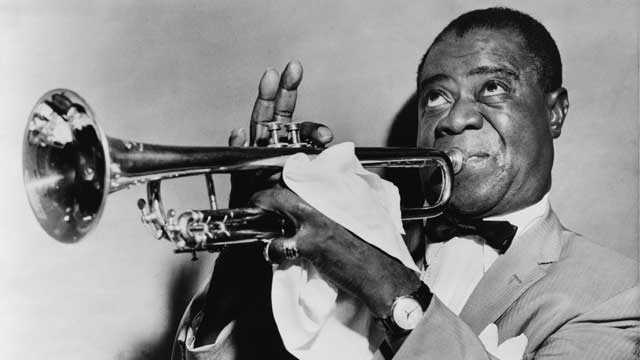
Just a few weeks ago, celebrations were held July 4 for famed New Orleans musician Louis Armstrong.
If you are of a certain age, you may remember numerous star-spangled musical tributes that aired on TV, often including a “birthday medley” of Armstrong’s greatest hits.
There are several recordings and videos of Armstrong being presented with a very elaborate cake at a July Fourth concert performance, with the audience singing him “Happy Birthday!”
But it was not his birthday.
Armstrong was born in New Orleans at the turn of the century in a rough neighborhood known as The Battlefield on the southern section of Rampart Street and was raised by his grandmother until age 5.
Armstrong dropped out of school at age 11 after reportedly shooting a gun in the air on New Year’s Eve. He spent the night at New Orleans Juvenile Court and was sentenced the next day to detention at the Colored Waif’s Home.
It was a strict and even harsh environment for young boys, but this is where Armstrong was introduced to the cornet. That first horn is on display at The New Orleans Jazz Museum, donated by The New Orleans Jazz Club, and you can see the story behind that horn by clicking here.
After he became famous, Armstrong always told everyone his birthday was July 4, 1900, possibly because it was an easy date to remember, so it was printed on several recordings, newspaper and magazine articles, and even on statues. Truthfully, he did not know his own birthday.
However, in the 1980s, historian Tad Jones discovered what is now accepted to be his actual birth certificate, with a date of Aug. 4, 1901.
That date is now celebrated with many musical events, including Satchmo Summerfest at The New Orleans Jazz Museum, which was held on Aug. 1 and 2 of this year. However, some organizations, including The Louis Armstrong House Museum, still have events that celebrate the July Fourth “birthday.”
While accuracy should always be embraced, many people, and especially musicians, embraced the utopian idea that a national treasure like Armstrong would be born on the same day as the nation.
Perhaps it’s appropriate that a man who was possibly the most important musical figure in the United States be honored with two different birthdays.
Below is a summary of the impact of Louis Armstrong’s life written by meteorologist Jim Syoen, who is also a jazz musician.
About Louis Armstrong:
On his 125th birthday, I’d like to take a moment and explain why Louis Armstrong matters.
As a sometimes New Orleans Jazz Musician, I have studied his music and read most of the books about his life, but I also had two very close friends who knew Louis Armstrong personally. I will include their anecdotes at the conclusion of this article.
Louis is very unique in the fact that he truly had four careers.
As most of us know, Louis was born and raised in New Orleans, where he learned to play cornet before eventually switching to trumpet. In the 1920s, he moved to Chicago at the request of his mentor, trumpet player King Oliver. In Chicago, he made what many people consider to be the most important jazz recordings of all time, the “Hot Fives.” They were recorded starting in 1925, and although the recording technology was archaic, these recordings have been cleaned up and are much more pleasing to the ear today than they were 50 years ago. Louis’ gift for improvisation on these recordings is extremely evident, and he is obviously far ahead of many of his peers musically. This is when he was considered one of, if not “the” pioneer of Jazz.
Starting in the 1930s, he became one of the first African American film stars. He appeared as a musician, singer and actor in many “shorts,” as they were called in the day, and then feature films as well. The most famous movies being, New Orleans, The Glenn Miller Story, and Paris Blues with Paul Newman. However, perhaps his best role was alongside Bing Crosby, Frank Sinatra, and Grace Kelly in the spectacular High Society, a movie that is as pleasing as a warm beignet on a Sunday morning.
During World War II, the big bands dominated the music scene, but in the late 40s in 1950s, Louis was among the musicians to start the “Dixieland Revival,” as it was called in its day, popularizing New Orleans Jazz again, opening the door for performers like The Assunto brothers and their Dukes of Dixieland, Pete Fountain, Al Hirt and Ronnie Kole.
During this time, he was also christened as “Ambassador Satch,” as the State Department actually sponsored many overseas tours to bring New Orleans Jazz to Europe and Africa. This is also the time period when he appeared on “The Ed Sullivan Show” frequently to promote his tours, and became known as “Louie,” as Ed would call him.
Musical tastes are always changing, and as rock ‘n’ roll gained huge popularity in the late 1950s and the British invasion started in the early 60s, New Orleans jazz was suddenly not as popular. To quote trumpet player Frank Assunto, a dear friend and colleague of Louis, “Once the Beatles hit, it was all over for us.”
However, the man who managed to knock the Beatles off the top of the charts, which they had held for three and a half months with five different recordings, was, you guessed it, Louis Armstrong, with “Hello Dolly,” making him the oldest musician to ever have a number one hit.
This started the fourth phase of Louis’ career, as he became “Pops,” the elder statesman of jazz, appearing on several television shows both in the United States and abroad, often performing the “good old good ones,” as he called them.
These are the songs that are New Orleans Jazz classics, that you can still hear in the French Quarter and on Frenchman Street today.
Oh, and lest we forget, in 1988, “What a Wonderful World” was featured in the movie “Good Morning Vietnam,” earning him a top 40 hit 17 years after his death, a song that was inducted into The Grammy Hall of Fame in 1999.
This is a very minor snippet of a man who brought joy to millions for over 55 years, a man that broke many barriers and produced music that is often imitated to this day.
And now, quite self-indulgently, I will relay these two Louis Armstrong anecdotes that were told to me by two people that knew him.
For many years in Florida, I worked with a great clarinet named Bob Schroeder. In the 1950s, Bob was a popular working jazz musician in St. Louis, and Louis Armstrong came to town to play a concert. Bob and a few fellow musicians went to the theater about three hours before showtime, hoping to have a chance to shake his hand. When Louis heard there were musicians at the stage door, he immediately waved them in and said, “Sit down, boys. What can I get you to drink?” They all cocktailed and told stories about other musicians, as musicians are quite wont to do. They had a wonderful 90 minutes before Louis went on stage. According to Bob, he could not have been warmer and more gracious. It was a joy to be in his presence.
My second anecdote comes from Deano Assunto, the president of The New Orleans Jazz Club, whose father Frank Assunto started the Dukes of Dixieland, a group that included Frank’s brother Freddie on trombone and their father “Papa” Jac on trombone and banjo The Dukes and Louis made several recordings together, performed on the same bill at several jazz festivals, and did many television shows together as well. The entire Assunto family were very close with Louis and his wife Lucille.
When the Assuntos were headlining in Las Vegas in the late 1950s and early 1960s, they often didn’t finish performing at the hotel until the early hours of the morning. However, young Deano knew who was coming to visit the next day when the wives got up at the crack of dawn and started cooking red beans and rice, as well as other New Orleans specialties. All of the ladies wanted to make sure that the minute Louis opened the door, he was greeted with the smells of his favorite New Orleans delicacies. Although Deano was a younger child during this period, he remembers Louis as being a wonderfully joyous man. He has numerous pictures to back it up!
Much of that joy can be heard in the 1960 “Louie and The Dukes” recording of Bourbon Street Parade, the “definitive” version of this classic song, according to historian Ricky Riccardi.
It’s almost impossible to end an article about a man whose music continues 54 years after his death, but a quote from Tony Bennet might be most appropriate.
“The bottom line of any country in the world is: what did we contribute to the world?
We contributed Louis Armstrong.
READ MORE:Historian clears up reason why there is confusion behind Louis Armstrong’s birthday