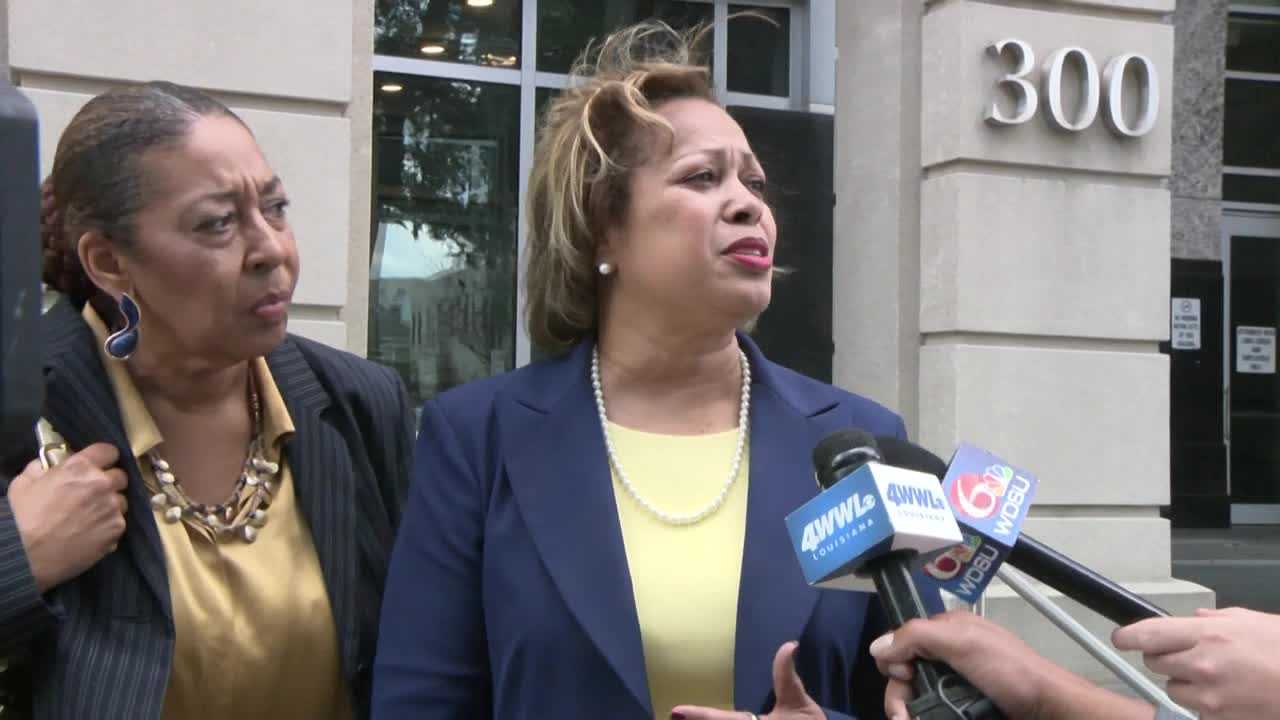
The Orleans Parish clerk of court appeared in a Baton Rouge court Monday after she sued New Orleans city leaders over resolutions regarding her position within the clerk of court.
Chelsey Napoleon appeared with her attorney in Baton Rouge regarding her lawsuit against members of the New Orleans City Council, Mayor Helena Moreno, and former interim clerk of court Calvin Johnson.
The hearing focused on the confusion over the clerk of court’s authority following recent legal and legislative changes.
The legislature passed a bill, signed into law by Gov. Jeff Landry, that combined the Orleans Parish civil and criminal Clerks. The law eliminated Calvin Duncan’s criminal court position, making Napoleon the clerk of both courts.
The New Orleans City Council signed resolutions that would remove Napoleon from her position and call a special election.
This move resulted in Louisiana Attorney General Liz Murrill sending letters to the council and Moreno, urging them to reverse course or risk being removed from office.
The Louisiana Supreme Court intervened, upholding Napoleon’s position as clerk and removing Johnson as interim until a final decision could be made regarding the law that combined the courts.
During Napoleon’s hearing, the judge said he would not rule because the Louisiana Supreme Court had already acted, making the matter part of the court record and sending it to the Supreme Court.
Napoleon, who was elected in 2018 and re-elected, testified that her office’s role is to provide information to the public and said she did not advocate for Senate Bill 256.
She also argued that competing claims to authority have created confusion, instability and public unease, including problems at polling locations where police were called to protect voting machines.
Napoleon’s attorney argued that nothing had legally terminated Napoleon’s term and that the transition process gave no real planning period.
An attorney representing the city argued the situation was unusual and questioned whether Napoleon’s oath only covered civil court duties. The attorney also emphasized that the new law moved quickly from passage to effect. The city also raised concerns about funding, arguing the criminal clerk’s office had been abolished without a clear funding source.
Testimony also touched on politics, including endorsements, the public’s vote for Duncan, and whether legislative action rather than an election had undermined public confidence.
Text messages and documents involving former Interim Clerk Johnson were discussed, including references to the title “interim clerk of court” and requested to remove that wording.
Emily Faye Ratner, a registered voter and Calvin Duncan’s campaign manager, testified about why she supported Duncan, saying she was moved by his story of spending 30 years in prison for a crime he said he did not commit.
She also described a “terrifying moment” when the attorney general sent a letter warning Duncan not to describe himself as exonerated.
Ratner testified that she thought Napoleon was over the clerk’s office following the legal back-and-forth, but admitted the situation was confusing to her, too.
In closing arguments, Napoleon’s attorney said voter concerns are legitimate but argued the core issue is the legislature’s action.
Her attorney maintained that nothing legally terminated Napoleon’s term, and that the city had no authority to appoint an interim clerk.
Napoleon’s attorney also said that the governor-signed law and the Louisiana Constitution permit restructuring.
The city’s attorney stressed that Duncan received more than 85,000 votes and took an oath of office prior to the state law being signed, combining the court.
The attorney stressed that whoever holds the position should be determined by voters, and said no one elected Chelsey Napoleon to hold that position in the most recent election.
According to the city’s attorney, leaders were not trying to abolish offices, but argued the law’s timeline was unconstitutional and said the city council acted properly because someone not elected was serving in the office and it needed to be corrected.
The judge presiding over the case decided not to rule in Napoleon’s matter and instead took the testimony into court record for the Louisiana Supreme Court to review.
READ MORE:New Orleans Clerk Chelsey Napoleon appears in court after suing city leaders over her position