Gas prices are climbing nationwide, averaging $4.08 per gallon.
Oil prices have also risen to over $100 per barrel, driven by the war in Iran and the closure of the Strait of Hormuz, a vital shipping channel controlled by Iran.
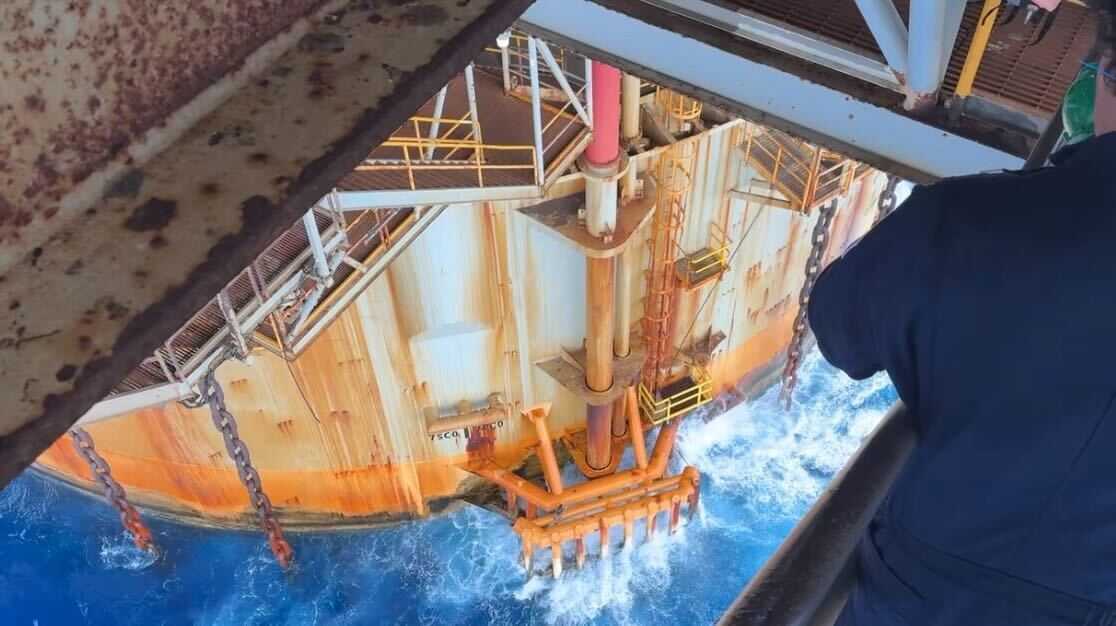
House Majority Leader Steve Scalise led a group of congressional members to Occidental Petroleum’s Holstein rig, located 194 miles south of New Orleans in the Gulf of Mexico, to examine offshore drilling operations.
The rig, one of the largest in the world, produces approximately 12,000 barrels of oil daily, employs nearly 180 workers, and features state-of-the-art facilities, including a control center, cafeteria, break areas and dormitories.
“This has been such a critical industry for Louisiana,” Scalise said.
He emphasized the state’s reliance on the oil and gas sector, which supports over 300,000 jobs.
Scalise also highlighted the importance of revenue sharing to fund coastal restoration projects that protect against future storms.
“We can produce more oil and gas, do it more efficiently, and do it at a lower cost,” said Andy Kershaw, head of Gulf operations for Occidental Petroleum.
Rep. Craig Goldman, who represents the Fort Worth, Texas area, stressed that the war in Iran has not impacted America’s ability to produce its own energy.
The United States of America is energy independent, said Goldman.
Rep. Cleo Fields, the only Democrat on the trip, stressed the need for domestic energy production to lower gas prices.
“This rig must operate in a prudent and economically, environmentally responsible way, and no one should back up on that. I’m certainly not. But we also have to be realistic; the production of oil and natural gas is a necessity for our communities,” Fields said.
The visit also marked the 16th anniversary of the Deepwater Horizon explosion, a disaster that led to significant safety improvements.
Even skeptics were impressed with the rig’s safety measures.
“I’m a pro-environmentalist, as you know, but I am impressed with the safety nets and safeguards they have on this platform,” Fields said.
Scalise said the goal of the trip was to reinforce the importance of bipartisan cooperation to address energy challenges.
“How do you get energy? Even if you have an electric car, you’re not plugging that thing into a tree. You’re plugging it into an outlet fueled by natural gas from this facility. If you shut it down, what are you going to replace it with? And having not only Republicans but Democrats understand that is critical,” said Scalise.
As lawmakers return to Washington, the question remains of whether this trip will lead to meaningful change in energy policy and lower prices for consumers.
Latest on the Iran war:
The U.S. military vowed to blockade all Iranian ports starting Monday, part of efforts to force Tehran into agreeing to open the crucial Strait of Hormuz and accepting a peace deal. Iran responded with threats on all ports in the Persian Gulf and the Gulf of Oman, taking aim at U.S.-allied countries.
That set the stage for an extraordinary showdown that posed serious risks for the global economy and raised the specter that a ceasefire that is currently holding could collapse and the war could resume. Talks aimed at permanently ending the conflict — which began Feb. 28 with U.S. and Israeli strikes on Iran — failed to reach an agreement this past weekend, and there has been no word on whether negotiations will resume.
It was not clear if the blockade had started when the designated time of 10 a.m. EDT (2 p.m. GMT) arrived. Minutes earlier, a notice to mariners issued by the United Kingdom Maritime Trade Operations agency, which monitors maritime security, said the restrictions included “the entirety of the Iranian coastline, including ports and energy infrastructure.”
The notice added that transit through the strait “to or from non-Iranian destinations is not reported to be impeded by these measures,” but it added that ships “may encounter military presence” in the strait.
Iran’s effective closure of the strait, through which 20% of traded oil passes in peacetime, has sent oil prices skyrocketing, pushing up the cost of gasoline, food and other basic goods far beyond the Middle East. Tehran has allowed some ships perceived as friendly to pass while charging considerable fees, leading to accusations it is holding the global economy hostage.
Some analysts are doubtful that the U.S. can restore normal shipping through force alone — and it’s not clear how a blockade would work or what the dangers might be to U.S. forces. The question is essentially who can endure the most pain: Could a blockade make Iran’s economic situation untenable and force it to concede? Or will it drive global oil and other prices so high that U.S. President Donald Trump is forced to back down?
President Trump orders military blockade of Strait of Hormuz after US-Iran negotiations fail
The blockade could have far-reaching effects
The U.S. military’s Central Command announced that the blockade would be enforced “against vessels of all nations entering or departing Iranian ports and coastal areas.” It said that would include all of Iran’s ports on the Persian Gulf and Gulf of Oman.
CENTCOM’s decision to allow ships traveling between non-Iranian ports to transit the strait was a step down from Trump’s earlier threat to blockade the waterway.
In a social media message posted shortly after the blockade was due to begin, Trump said Iran’s navy was “laying at the bottom of the sea, completely obliterated,” but he added that Tehran still has “fast attack ships,” and warned that “if any of these ships come anywhere close to our BLOCKADE, they will be immediately ELIMINATED.”
Iran issued threats of its own.
“Security in the Persian Gulf and the Sea of Oman is either for everyone or for NO ONE,” the Islamic Republic of Iran Broadcasting reported Monday. “NO PORT in the region will be safe,” read a statement from the Iranian military and the Revolutionary Guard.
The threats halted the limited ship traffic that resumed in the strait since the ceasefire, according to a report from Lloyd’s List Intelligence. Marine trackers say over 40 commercial ships have crossed since the start of the ceasefire last week, down from roughly 100 to 135 vessel passages per day before the war.
The blockade is likely intended to pile pressure on Iran, which has exported millions of barrels of oil since the war began, much of it likely carried by so-called dark transits that evade Western sanctions and oversight.
But the effects will be felt far beyond Iran. The price of Brent crude oil, the international standard, rose 7% to hover around $102 per barrel on Monday. It cost roughly $70 per barrel before the war.
Israeli Prime Minister Benjamin Netanyahu, who has come under domestic criticism for the inconclusive outcome of the war, expressed support Monday for Trump’s “strong stance to impose a naval blockade on Iran.”
But traditionally close U.S. ally Britain will not be part of the blockade, Prime Minister Keir Starmer told BBC radio Monday, adding his country is “not getting dragged into the war.”
Latest on oil prices:
Oil prices rose in early market trading Sunday after the U.S. said it would blockade Iranian ports beginning Monday.
The price of U.S. crude oil rose 8% to $104.24 a barrel and Brent crude oil, the international standard, rose 7% to $102.29.
Brent crude has swung dramatically during the Iran war, rising from roughly $70 per barrel before the war in late February to more than $119 at times. On Friday, ahead of the peace talks, Brent for June delivery fell 0.8% to $95.20 per barrel.
Iran has been effectively controlling the Strait of Hormuz, a key waterway for global oil shipping.
U.S. Central Command said the blockade would be “enforced impartially against vessels of all nations” entering or departing Iranian ports and coastal areas, including all Iranian ports on the Persian Gulf and Gulf of Oman
It said it would still allow ships traveling between non-Iranian ports to transit the Strait of Hormuz.
US military says it will blockade Iranian ports after ceasefire talks ended without agreement
Around a fifth of the world’s traded oil typically flows through the Strait of Hormuz every day. Saudi Arabia, Iraq, the United Arab Emirates, Kuwait, and Iran are all major exporters.
Traffic in the strait has been limited even in the days since the ceasefire. Marine trackers say over 40 commercial ships have crossed since the start of the ceasefire.
Claudio Galimberti, chief economist of Rystad Energy, said the blockade will raise prices but might move the needle on talks.
“It means the oil markets will be even tighter than before,” he said. “However, I think this is a negotiation tactic, which eventually resolves into a full opening of Hormuz. So, more pain now, but more gain later.”
However, Jim Krane, Energy Research Fellow at Rice University, said the blockade might be effective as a long-term strategy to impose pain on the Iranian economy, but it isn’t a good short-term negotiating tactic when the oil market is already under strain.
“If the deficit to the oil market takes another jump it is going to impose pain on every person on Earth that’s subject to market oil prices,” he said.
READ MORE:As gas, oil prices surge, WDSU tours one of the world’s largest oil rigs off Louisiana’s coast