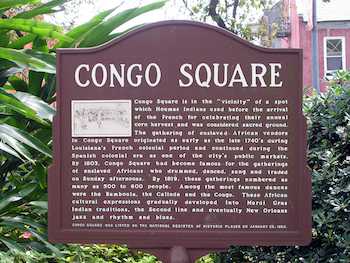
At the juncture where the French Quarter meets Treme, where the ramparts originally separated “back of town” from the rest of the city, is Congo Square, the birthplace of our cultural heritage.
“It’s our reference point for the for African centered activity in New Orleans,” said historian Freddie Williams Evans.
She wrote the book on Congo Square.
“It was also a place for Native Americans to come together before the founding of the city,” Evans said.
Before New Orleans ever was, the land was called “Bulbancha,” a native term meaning “the place of many tongues.”
The area was a gathering place for the Houma, Chocktaw and Chitimacha people.
“So this area has always been an important place for the people, the people of the land. and so they were the first people here,” Evans said.
For enslaved Africans who were stripped of everything during the Middle Passage, they managed to salvage something from their homeland.
“That was their cultural memory that embodied their songs, their dances, their food, and foodways,” Evans said.
So drum circles and dancing, and selling food and wares, merchants and marketplace were all common for big Sunday gatherings.
The rhythm and sounds of the drum circles were the seeds for American music. Ragtime and jazz both have roots in Congo Square.
“Nobody really gives Congo Square the credit it deserves,” Evans said. “Congo Square to me is not just a box. I want them to see the wider view of Congo Square.”
While the Sunday gatherings seemed joyous and drew crowds, preserving African cultural practices at the time was an act of resistance.
“We have a treasure here that is so underrecognized and so understudied,” Evans said.
If New Orleans marches to its own drum, the beat came from Congo Square. A cadence that reaches back before the trans-Atlantic slave trade and is wired into our DNA.
Everything you love about New Orleans has its roots in Congo Square; its influence is foundational to American music and culture.
Congo Square is where the circle can be unbroken and where we can trace the lines of our multi-faceted heritage.
The lore of its angles points to buried secret treasures, and its four corners hold all the magic that is uniquely New Orleans.
READ MORE:Tracing the roots of Congo Square