Five months after the explosion and fire at the Smitty’s Supply facility in Roseland, newly obtained federal inspection records detail what investigators say they found inside the property and why neighbors say their concerns are growing rather than fading.
An Environmental Protection Agency inspection conducted in early October spans more than 200 pages of photographs, site maps and written observations. Inspectors documented widespread damage across multiple tank farms, warehouses and outdoor storage areas. According to the report, investigators counted more than 200 individual spill areas, at least 250 damaged or deteriorating containers, and more than 300 containers that were either unlabeled or could not be identified.
The inspection describes buckled storage tanks that once held base oils, secondary containment walls that were cracked or beginning to collapse, and standing oily water pooled inside containment structures. In several locations, inspectors noted active drips of unknown liquids, containers stacked on broken pallets, and chemical totes cut open or overflowing after rainfall. The report also details repeated observations of strong hydrocarbon or solvent odors, suggesting releases inspectors said were difficult to trace because of blocked access paths and unsafe conditions.
Inside the grease plant and warehouse areas, inspectors documented open drums, leaking containers, saturated cardboard used as makeshift walkways, and thick layers of grease buildup on floors, equipment and catwalks. In warehouse storage areas, investigators observed unstable stacks of pallets, containers marked “off-spec,” “expired,” or “do not use,” and spills of antifreeze, oil and other liquids that had either been partially absorbed with pads or left uncovered. In some sections, inspectors noted incompatible materials stored close together, including corrosive and flammable substances.
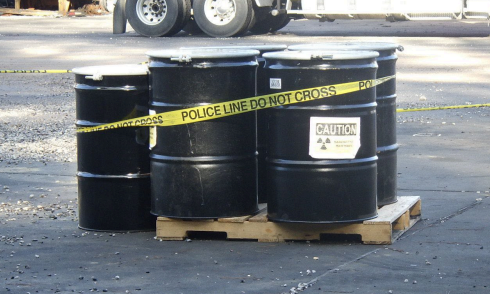
One of the findings drawing particular attention was the presence of barrels marked “radioactive” without clear labeling of their contents. Inspectors also identified numerous leaking lead-acid batteries, open buckets of unidentified liquids and drainage ditches and puddles filled with oily residue near the property’s perimeter. The report further outlines concerns about hazardous waste determinations, container management practices, inspection logs, accumulation timelines and the facility’s contingency planning.
Community members living near the site say the findings reflect what they have been seeing and worrying about for months.
Jody Hart, a retired disabled veteran who lives less than a mile from the plant, said, “I live a half a mile from the site, and that’s scary.”
Hart said flying his drone has become routine.
“Dozens. I fly just about every day,” he said.
He added that the goal is awareness.
“To keep your awareness up,” Hart said.
After reviewing the inspection report, Hart described his reaction.
“I was. And then when I went to look at it for the first time, I was like, wow, about who knows what’s in there,” he said.
He said the impact on his life has been significant.
“Very personal. I moved here looking for a quieter life, and it’s absolutely devastating,” Hart said.
He added that many neighbors feel overlooked.
“Yeah, we feel like we haven’t been heard, like it’s been swept under the rug,” he said.
Other residents describe limiting outdoor activities for their children.
One Roseland mother said, “There’s still not enough information; it really is a big deal.”
She said daily routines for her family have changed.
“We don’t even let her play outside. She’s not allowed to play outside. I mean, we kept her off the playground at school. We’ve moved her out of the school,” she said.
She added that long-term plans, such as moving away, feel out of reach.
“I wish we could move. We can’t go anywhere. Our house is unsellable. Who wants to buy a house next to Ground Zero?” she said.
The situation has also drawn attention from state lawmakers, with questions focusing on how the violations occurred, whether enforcement actions have been strong enough and whether existing environmental laws need additional enforcement.
State Rep. Robby Carter, whose district includes the area, said, “a lot of violations to still allow and be in business.”
Carter also raised concerns about the timing of cleanup efforts.
“Things like that bother me because when the site was turned back over, we were under the understanding that cleanup would begin immediately, and we haven’t seen that,” he said.
After reviewing inspection photographs, Carter added, “I find it very concerning that EPA has pictures showing radioactive waste.”
He said enforcement may be part of the issue.
“We have a good set of laws in Louisiana now, but I’m having the staff at the legislature check to see if some of them need to be tweaked. I think enforcement may be more of a problem in the law,” Carter said.
He added that the focus should remain on residents.
“How do we solve the problem for the people of Roseland and the surrounding area? They are the ones that count. We need to get them answers, and they want to know answers now,” he said.
Court records show multiple civil lawsuits and regulatory proceedings tied to the aftermath of the explosion, including a class-action lawsuit involving thousands of participants.
Smitty’s Supply provided WDSU the following statement regarding cleanup efforts and coordination with regulators:
“Smitty’s Supply is prioritizing environmental remediation at the Roseland site and is working closely with the U.S. Environmental Protection Agency and the Louisiana Department of Environmental Quality to carry out a comprehensive and responsible cleanup program.
Since the August fire, our team has been working cooperatively with EPA and LDEQ to meet the requirements of the EPA’s RCRA corrective order. We are making steady, daily progress toward completing the agency’s required actions, guided by robust safety protocols and ongoing regulatory coordination.
Already we have properly disposed of or recycled 2,046 empty totes and drums, consolidated and recycled empty firefighting foam totes, disposed of waste from the grease plant, nearly completed pressure washing in the grease plant, completed cement work to support the installation of new electrical poles, properly disposed of used oil and used oil filters from Warehouse 10, transferred product from damaged containers into compliant containers and labeled products and transferred labeled containers into above-ground storage tanks. Detailed reports documenting this work are submitted each week by Smitty’s Supply and our partners to the EPA and LDEQ. These reports are publicly available.
As cleanup efforts continue, all water on our site, including rainwater, is collected, stored and treated on site using a water collection and treatment system from Spectrum Water. The water goes through multiple treatment and filtration steps and is being tested and reviewed by regulators.
We remain committed to completing all required actions safely, transparently and in coordination with our regulatory partners. While the road to rebuilding takes time, we are confident in the progress being made.”
State and federal agencies confirm investigations and enforcement actions remain active. Community members say they want clear answers, visible progress and reassurance that the conditions documented in the inspection will not become a permanent part of life in Roseland.
READ MORE:EPA report fuels resident and lawmaker concerns over conditions at fire-damaged facility